‘The Horse in Motion’ gallops onto The Image Centre at TMU
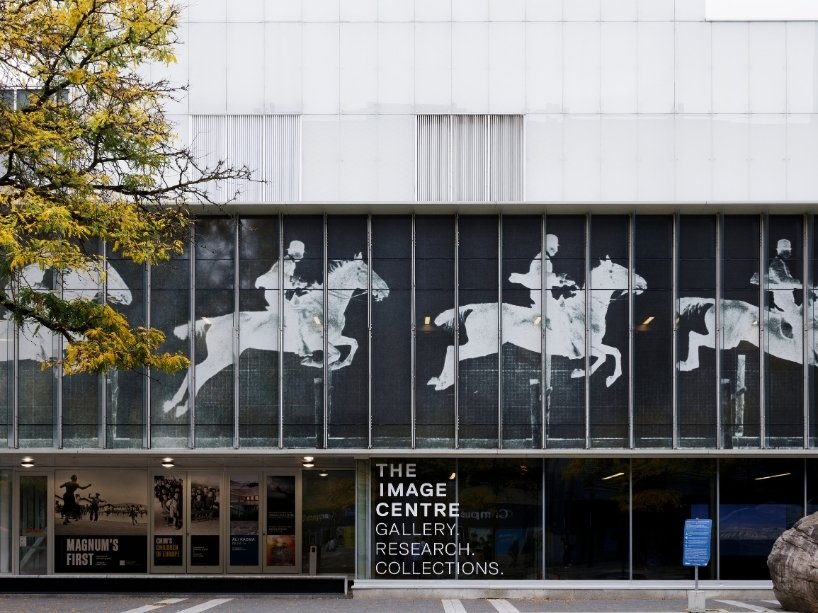
Above, the new exterior wrap on The Image Centre, featuring The Horse in Motion. In 1878, photographer Eadweard Muybridge set up a line of cameras to capture a horse in full gallop—proving for the first time that all four hooves leave the ground and sparking the birth of motion pictures. (Photo: The Image Centre (exterior), 2025 © Andrew Savery-Whiteway, The Image Centre)
The Image Centre at TMU is on the move.
The building recently received a dramatic new exterior, featuring frames from Eadweard Muybridge’s iconic 19th-century series Animal Locomotion, the legendary photographs that first launched cinema.
In this Q&A, The Image Centre director Paul Roth shares why this historic work was chosen for the university's on-campus gallery, how it reflects the creative energy in the building they share with the School of Image Arts, and the impact it will have on the TMU community and beyond.
When thinking about the next public art mural for our building facade, we wanted something that reflected the creative activity happening inside.
We chose this classic image of a horse galloping and leaping over hurdles from Eadweard Muybridge’s Animal Locomotion series. These photographs, aimed at capturing movement over time, led to the invention of motion pictures.
Everyday, students in The Creative School experiment with images, moving fluidly between digital and analogue still photography, as well as film and digital video, to produce every kind of creative expression.
The Image Centre, housed in the same building, is a world-class museum and research hub for photography that exhibits both still images and media arts. For this reason, Muybridge was perfect for this project. His work represents the connection between these two practices, and has become the world’s most recognizable metaphor for the birth of motion pictures from photography.
This photo, along with the many photographs he made capturing the movements of animals and humans in the passage of time, were revolutionary.
Muybridge was first commissioned to photograph a horse in the 1870s by the wealthy American businessman Leland Stanford, who wanted to clearly see and understand the horse’s gallop—for example, were all four legs ever off the ground at the same time?
To get the images Stanford wanted, Muybridge had to figure out how to capture motion using a technology that was very slow at the time.
He came up with a whole methodology for doing this. He triggered a sequence of cameras one after the other on a constructed track as he staged different movements. Later, as his experiment expanded, Muybridge captured the motion of other animals, and humans too.
When he put these sequential images together, they captured the full range of locomotion and were incredibly revealing. They led to a key discovery: images shown in rapid succession could create a convincing illusion of motion.
So they became the forerunner to motion pictures, to videos, and ultimately to the images we all make on our smart phones.
Yes. By providing irrefutable evidence that horses gallop with all four feet off the ground at once, these pictures captured something that you cannot see with the naked eye. His work proved that photography could expand human vision by revealing things that were impossible to see otherwise.
In other words, photography is more than a medium for recording what we see—it’s a medium for discovering what we cannot.
This makes Muybridge’s photographs particularly compelling at a research university, where our goal is to expand knowledge and discover what we couldn’t otherwise know.
Public art installations like this one draw public attention. They have a way of making people stop and say, “What’s that about?”
My hope is that people passing through TMU’s campus see and are struck by this amazing, dramatic image of a horse as it gallops and leaps across the building.
If they already know this is an image by Muybridge, then what they see will be a clue about what’s happening inside—that there’s a museum of photo history, a school where students and their teachers make photographs and films, and a place where people think daily about cameras and images and how we can use them to represent and understand the world and our dreams.
Overall, our hope is that the mural prompts curiosity and discovery, inspiring people to explore the exhibitions and programs offered by The Image Centre and Image Arts at The Creative School.
I find Muybridge to be one of the most endlessly interesting figures in the history of photography, and his pictures are always fascinating to look at and think about. I also love the idea of making a contemporary public artwork out of a historic photograph from the 19th century.
The Image Centre’s building has hosted rotating public art installations for more than a decade. These installations typically stay up for several years before being replaced with new work.
The exterior wrap at the The Image Centre, called “The Horse in Motion,” is currently on display. The Image Centre is open to everyone within the TMU community and the general public.
The exterior wrap at the The Image Centre, called “The Horse in Motion,” is currently on display. The Image Centre is open to everyone within the TMU community and the general public.