Growing the future: TMU student explores living building materials in Venice

For TMU architecture graduate student and 2025 Venice Architecture Biennale participant Raya Allataifei, designing the buildings of tomorrow means reimagining how we build today. Photo credit: Neuf Architect(e)s
When most people think about sustainable building, they imagine solar panels or energy-efficient windows. But Raya Allataifei is thinking bigger—and smaller. The TMU architecture graduate student is growing building materials from mushrooms.
Her innovative work with mycileum (mushroom root networks) caught the attention of the Canada Council for the Arts, which selected her from over 200 applicants to attend the 2025 Venice Architecture Biennale (external link) , an international showcase of architectural innovation, this past June.
As part of her Canada Council fellowship, Allataifei contributed to the Canadian Pavilion, a “living structure” created by Andrea Shin Ling and the Living Room Collective. At the same time, she conducted her own independent research, which closely aligned with the Biennale’s theme of natural intelligence in architecture and will feed directly into her master of architecture thesis at TMU.
From curiosity to innovation
Allataifei’s path to sustainable architecture began in Iraq, where she first became fascinated with how buildings shape our world. This curiosity brought her to Canada for undergraduate studies, then to Stuttgart University in Germany in 2024 for an academic exchange that would change everything.
In Stuttgart's biomaterials laboratory, Allataifei helped create the largest reinforced mycelium panel in the lab's history. These panels showed how mushroom-based materials can work as sustainable and regenerative alternatives to traditional building materials. More importantly, her team demonstrated how reinforcement techniques can make mycelium strong enough for real construction projects.
The timing couldn’t have been better. The Biennale’s focus on natural intelligence made Allataifei’s work a natural fit, and her time in Venice gave her a platform to share ideas and engage with architects and researchers from around the globe.
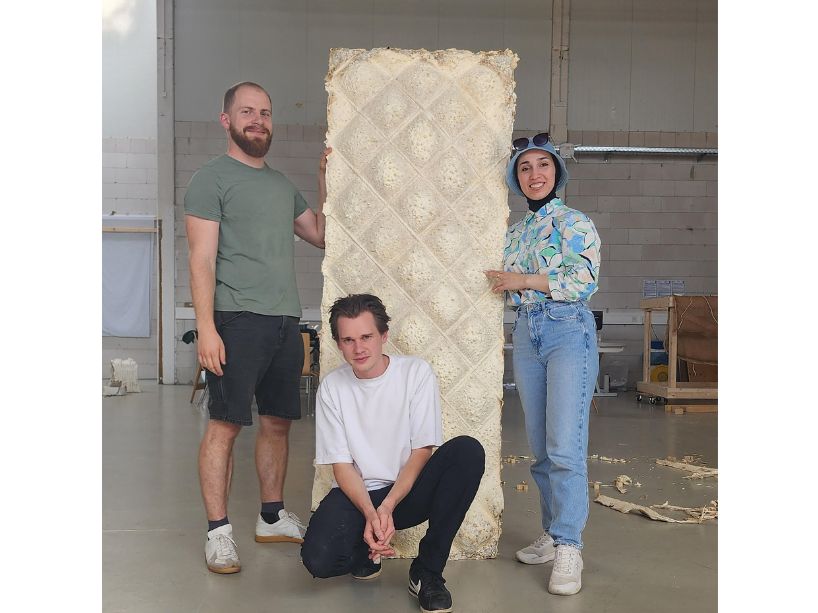
In Stuttgart, Germany, Allataifei (right) joined collaborators in constructing one of the largest mycelium panels to date, an experimental structure showcasing the potential of living materials in sustainable architecture.
Rethinking sustainability
For Allataifei, true sustainability goes far deeper than most people realize.
“I think a lot of people don’t realize just how deeply unsustainable many of our current practices still are,” she says. “Even buildings that meet sustainability standards like LEED often don’t consider what materials are used, or where they come from. We might reduce operational energy use, but what about the embodied carbon cost of the concrete itself?”
Her time in Germany opened her eyes to a completely different approach to green building.
“In Germany, the mindset is completely different. They think about the entire lifecycle of a building, from how it’s built to what happens when it’s torn down,” she explains. “I was shocked by how far ahead they are in their thinking. The academic institutions, the architecture studios, the materials research, it’s all integrated in a way we’re still catching up to in North America.”
This holistic thinking connects directly to Allataifei's research, which explores the Greek term technē-physis—the intersection of human technology and natural systems. Her core message is clear: we need to work with nature, not against it.
“Buildings today are graveyards for materials,” Allataifei says, echoing a phrase from Mark Gorgolewski, former chair of TMU’s Department of Architectural Science and author of Resource Salvation (external link) .
“It’s a provocative statement, but one that really stayed with me,” she adds. “We treat building components as disposable, but we shouldn’t. Architecture should be regenerative. It should give back to its surroundings, not just take from them.”

Allataifei in Venice in 2025 for the The Venice Biennale of Architecture, the international exhibition held every two years that showcases innovative architectural works from around the world.
Lessons from Venice
The Venice Biennale exposed Allataifei to global perspectives on sustainability.
What she saw confirmed her suspicions: European institutions are ahead of many of their North American counterparts when it comes to biomaterials and environmental innovation.
“Once I saw what was possible, I couldn’t unsee it,” Allataifei says. “I realized that if we rethink the ingredients of our buildings from the very beginning, we can make a huge impact on the sustainability of the entire built environment.”
As a Canada Council Fellow, Allataifei contributed to the Canadian Pavilion, a standing “living structure” created by Andrea Shin Ling and the Living Room Collective, with research support from ETH Zurich. The fellowship gave her the opportunity to work closely with the team on-site, maintaining the installation, preparing materials and engaging with visitors of all ages who came to learn about bio-materials and their potential to reshape architecture.
Experiencing this living experiment in person only confirmed Allataifei’s belief in bio-materials, as it was the first time such a bacterial structure had been exhibited at this scale outside the lab on a world stage. This interactive experience allowed her to study the materials’ behaviours directly, connecting with her broader research interests.
Allataifei also spent the month in Venice documenting ideas, speaking with specialists and recording architectural innovations that connected directly to her thesis work at TMU. Her research focuses on mycelium and how architects can move beyond “less harmful” sustainability toward regenerative design, an approach that restores and redefines the relationship between buildings and the environment through cooperation rather than depletion.
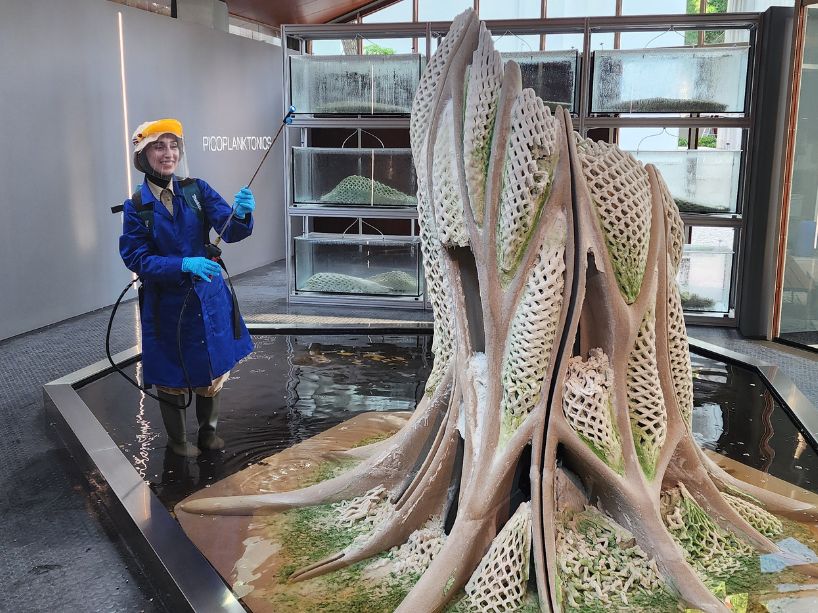
Allataifei stands beside the Picoplanktonics structure at the 2025 Venice Biennale of Architecture, a 3D-printed installation by Andrea Shin Ling and the Living Room Collective. The work explores the use of bio-materials to address the climate crisis from an architectural perspective.
Continuing the research at home
That revelation continues to guide Allataifei’s work today. Having completed a research fellowship with the Canadian Centre for Architecture (CCA), she is now pursuing her thesis at TMU, where she is exploring how natural intelligence—systems and structures inspired by nature—can inform future building design.
Her Canada Council fellowship provided a crucial stage for attending the Venice Biennale, where engaging with the Picoplanktonics living structure left a lasting impression. With mentorship from her thesis supervisor at TMU, Vincent Hui —professor in the department of architectural science, and member of the Living Room Collective behind the pavilion — she was able to connect her academic research with hands-on experience on a global stage.
From exchange programs and co-op placements to independent research opportunities at TMU, each step has reinforced her commitment to academics. While her professional experience includes roles at Neuf Architect(e)s and Serotiny Group, she knew academic research was her calling.
She now hopes to bring the creativity and experimental mindset she witnessed in Europe back home to North American architecture.
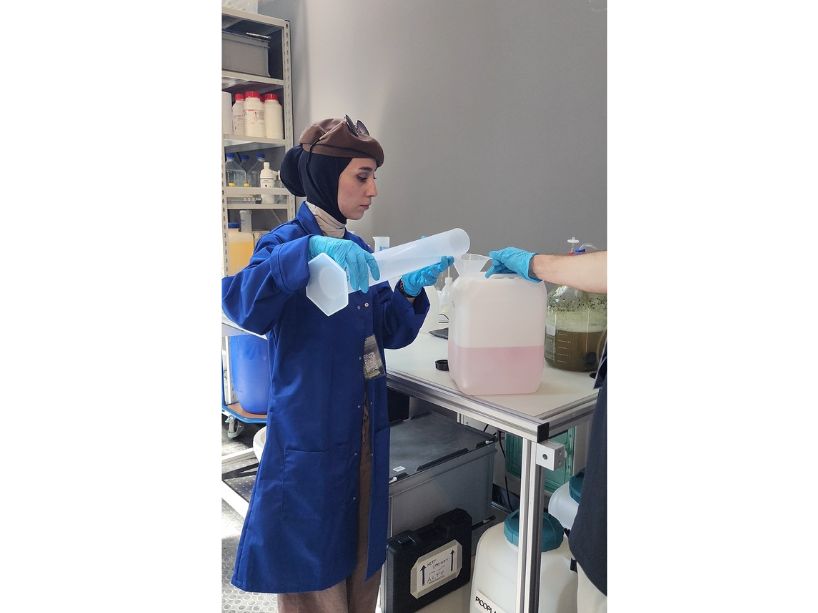
Allataifei is currently searching for lab facilities at TMU to continue the mycelium research she began in Stuttgart. While the German lab had specialized spaces for different stages of the process, she’s looking for a suitable space at TMU to support larger-scale projects, a key step in advancing her work.
Advice for new architects
For TMU students and graduate students, Allataifei’s advice is simple: “Get involved. Be part of the conversation. History and theory are important, but what matters is how we move forward and how we contribute to the urgent questions of our time.”
Though she’s still early in her career, Allataifei’s vision is clear: a future where buildings don’t just meet standards, they set new ones. Where architecture actively helps restore the planet rather than depleting it. And where innovative designers like her help build that future, one mushroom panel at a time.