That’s a wrap: Final health-care series event inspires next gen leaders
Dream big. That was the core message delivered to Peel District School Board (PDSB) students at the final Future of Health Care series event.
The program is an innovative partnership with Toronto Metropolitan University’s School of Medicine and Faculty of Community Services (FCS), designed to expose students to different career paths in health care.
“This initiative reflects our deep commitment to building the School of Medicine, not just in Brampton and the Peel Region, but with the community,” said Mohamed Lachemi, TMU president and vice-chancellor, during opening remarks.
“Over 1,100 students from across Peel have had the opportunity to engage with diverse leaders in healthcare, explore future pathways, and begin to imagine what’s possible – for them and for their communities," he continued.
The culminating event was held on May 15 at the PDSB Central Office in Mississauga.
It brought together over 250 students, educators, school leaders and health-care professionals.
The day featured dynamic workshops and career-focused discussions aimed at encouraging students to see themselves as the next generation of health-care providers and leaders.
"The Future of Healthcare program is more than a career pipeline — it's a promise to young people in diverse communities that they belong in medicine and health care,” said Rashmi Swarup, PDSB director of education.
“By connecting students with mentors, role models, and real opportunities, we are transforming representation and building a more inclusive, equitable health system from the ground up.”
The series is designed to boost representation in health-care fields and build a commitment to equity and positive change in health care.
Engaging youth through interactive learning
The Future of Health Care series brought together health-care leaders from different fields over a series of panel discussions. In this final event, students participated in interactive workshops, learned first-aid techniques, made medical assessments and explored real-world health-care scenarios.
They also heard about the personal and professional challenges and triumphs of health-care professionals.
In the workshop Think Like an ER Doctor: Navigating Emergency Medicine, TMU’s Dr. Dominick Shelton, Dr. Tajinder Kaura and Dr. Teresa Chan, led students through CPR practice on mannequins.
The students learned how rapid decision-making can save lives. The emergency physicians also shared insights on their profession with students.
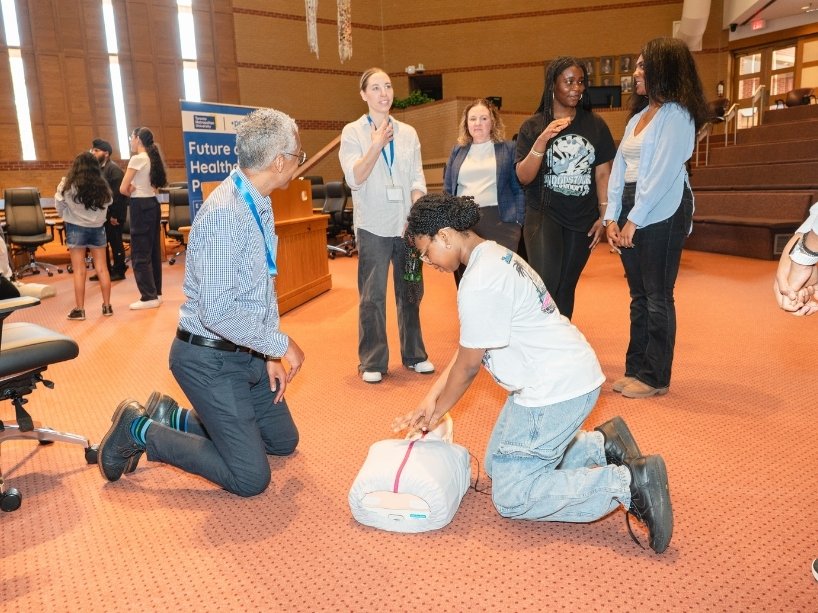
Dr. Shelton shared his experience as an emergency physician and the critical and life-saving difference CPR can have when every second counts. He was one of several health-care professionals participating in the Future of Health Care series designed to encourage young people to envision themselves as doctors, nurses and other health-care providers of the future.
Dr. Jobin Varughese, interim assistant dean of primary care education at TMU and president of the Ontario College of Family Physicians, led the session, A Day in the Life: The Evolving Role of Family Physicians, which immersed students in a family practice diagnostic scenario.
The students analyzed symptoms, proposed diagnoses and learned the importance of clinical curiosity, continuity of care and patient-doctor relationships.
Family doctors are integral to health care because they understand their patients' histories, social contexts and stories over time, he explained.
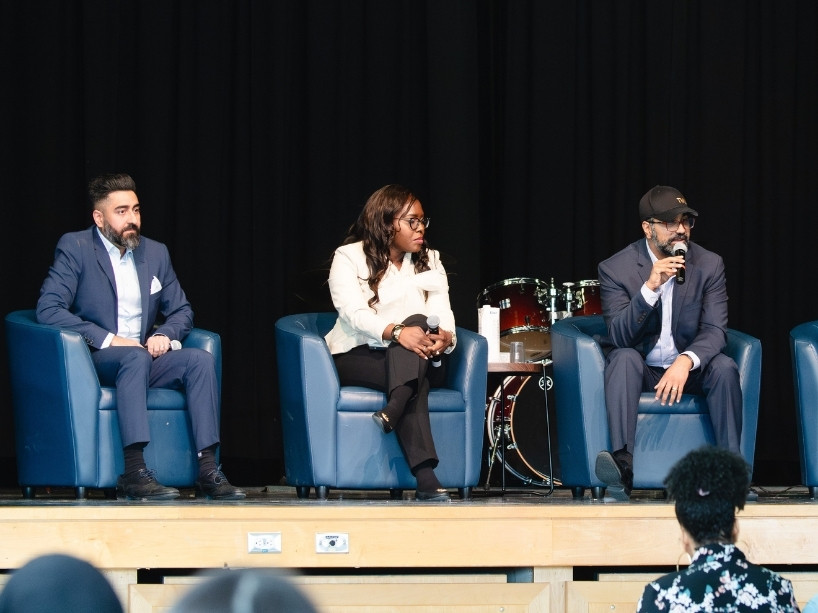
The Future of Health Care program featured a series of panel discussions with health-care professionals including Dr. Tajinder Kaura (left), Dr. Trudy McFarland (middle) and Dr. Jobin Varughese (right). In the final event, Dr. Kaura and Dr. Varughese facilitated interactive workshops to engage highschoolers and ignite their career ambitions.
“Being a family doctor means building trust and rapport,” said Dr. Varughese. “Patients can range in age from infants to a geriatric phase of life so adaptability is a key skill for family physicians.”
He also discussed the realities of medical practice, including the significant time spent on documentation. This gave students a realistic look at both the challenges and rewards of the profession.
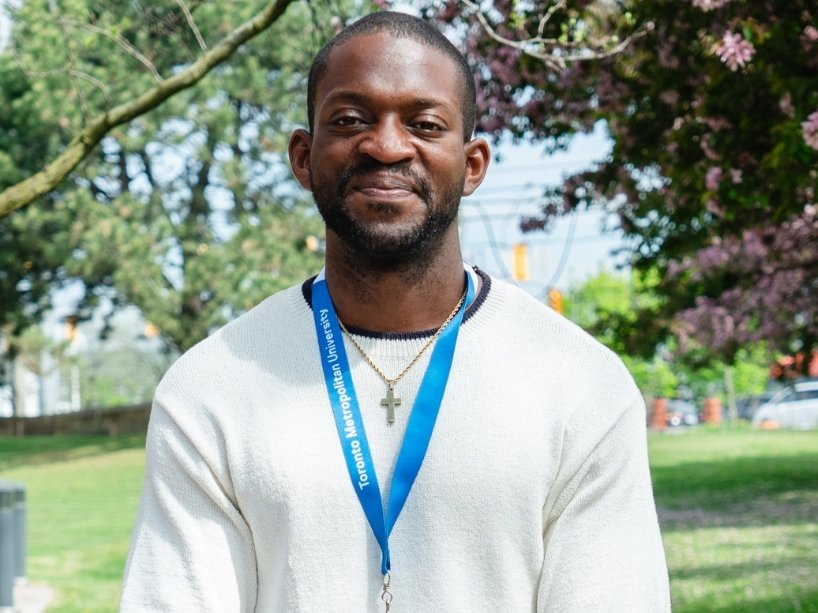
TMU nursing student Levar Bailey facilitated an interactive workshop at the final PDSB Future of Healthcare event, providing insights on emergency medicine and collaborative care. (Photo: Michael Morgan, Peel District School Board)
In A Day in the Life: Nursing & Youth Coach, fourth-year TMU nursing student Levar Bailey and youth worker Deshawn Hibbert led student volunteers through an urban hospital-based simulation.
The exercise brought to life the challenges of working in a downtown hospital in responding to youth affected by violence, and the importance of teamwork in coordinating care for them.
Bailey is a clinical extern in the emergency department, while Hibbert is a coach in the THRIVE program (Toronto Hospital-based Reducing Injury from Violence Intervention and Evaluation), a pioneering intervention and research initiative led by St. Michael’s Hospital.
THRIVE supports young victims of violence, particularly gun violence, helping to break the cycle and save lives.
The program provides wraparound support, including goal-setting, capacity-building programs and connections to critical resources such as education, housing and mental health services.
The emphasis on continuity of care after hospital discharge is what makes the program a model for health-care intervention, Bailey explains.
He also highlighted how collaboration is at the heart of the program’s success, bringing together nurses, youth workers and interprofessional health-care teams that provide medical, mental health and social supports.
Annette Bailey, associate dean, graduate studies and internationalization at TMU’s Faculty of Community Services is one of a number of partners that supports the initiative, which is funded by a CHIR grant and by Dr. Caroline Snyder at St. Michael’s Hospital.
Annette Bailey’s research program is focused on gun violence prevention and survivorship. She contributes to violence prevention decisions and strategies at municipal, national and international levels, that serve victims and survivors of gun violence.
She was also in the audience in support of her son Levar, proving that a passion for health equity and social justice, especially for underserved communities, runs deep in this family.
What’s next
TMU and PDSB have recently announced the expansion of the Future of Healthcare program to include a credit course for PDSB students that will strengthen pathways to postsecondary education.
The launch of Equity in the Future of Healthcare, a 13-week course for 25 PDSB high school students will explore health equity and health-care careers as part of their co-op requirement.
Students will engage with TMU faculty, receive mentorship, visit university labs and learn through case studies and guest lectures from diverse health professionals.
The program aims to create equitable pathways into health care by offering real-world learning experiences and fostering youth health-care career ambitions.
The Faculty of Community Services course will be offered through the Chang School and students will earn a credit which can be applied toward a TMU degree — while gaining exposure to fields like nursing, midwifery, nutrition, public health, family medicine and social work.
“At TMU, we are guided by our core values of innovation, community engagement and access to education,” said Lachemi. “The Future of Health Care program brings all three to life. And this is just the beginning.”