How The Creative School is creating leaders of today—and tomorrow
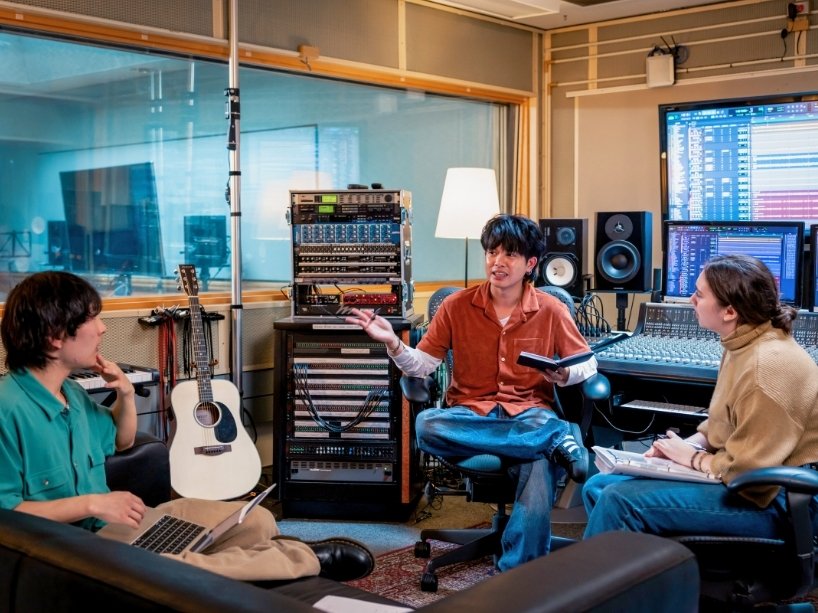
Students from different disciplines come together in the Multitrack Recording Suite, reflecting The Creative School’s emphasis on collaboration and adapting to an evolving creative landscape.
Long before the pandemic, The Creative School saw that change was brewing.
Technological shifts, evolving audience expectations and a new kind of demand from both students and employers was taking hold, impacting media, communication, design, creative industries and more.
As the school began planning to adapt its curriculum to meet the shifting landscape, the pandemic hit, and conventional norms of communication were shattered.
“All of a sudden, we had new tools. Online literacy exploded. AI became a part of the picture. That’s when it became even more clear: the conditions for transformation were not only present, they were urgent,” said Dean Charles Falzon.
Over the last few years, the school accelerated its plan to adapt for the future.
This fall, programs in The Creative School will launch a bold, reinvented curriculum designed to prepare students to lead in a world full of disruption and constant change.
“We helped shift a mindset. We must be in the now—more so than traditional academic institutions have ever been. And today, I’m excited about where we’re at,” Falzon said.
In the Q&A below, hear from Falzon about why this renewed curriculum will not only be key to the success of future graduates—but make them industry leaders.
Before the pandemic, it became very clear that various movements of change were converging across communication, design and creative industries—whether in media, journalism or other sectors—driven by technology and evolving public demands.
Another big change was happening in education itself. Students wanted to learn differently and wanted their education to prepare them more fully for the future.
A shift also came from industry: professionals are now looking for different kinds of talent—not just high academic achievers, but those with creative, innovative and entrepreneurial thinking.
With all of those changes happening at once, we began a deep reflection a few years ago on how we could best be “future ready”—not just as educators, but as collaborators with industry to prepare students.
We also began developing an international perspective and adapting to global needs. We now live in a culture where disruption is the norm, and our education must include disruption as part of its design.
Yes. About five years ago, we changed the name of the faculty to The Creative School. We intentionally designed a plan that emphasized both the depth of the discipline and the horizontal crossover—valuing transdisciplinary innovation hubs, international expansion and transdisciplinary learning opportunities.
That shift resonated strongly with advisors, industries and students.
The 360 Project emerged from the planning and rethinking about how we could best position ourselves in a constantly changing world. In collaboration with my Associate Dean Natalie Alvarez and my leading Directors, Dan Greenwood and Marie Crosta, we embarked on a major research review and innovative rethink.
We asked, ‘What should every student, regardless of major, have at the core of their education?’ ‘How can we retain disciplinary depth while enhancing how it is applied across fields?’ and 'How can we do this in the most impactful and efficient manner?’
We built a transdisciplinary curricular approach—one where students don't just study within their own field, but learn to collaborate across disciplines. This led to the concept of ‘clusters’, where curriculum, students and sometimes even courses overlap, complement and build on each other.
For instance, you could be studying graphic communications or television production, but find yourself contributing to the creation of a new video game. Or, you could be studying emerging technologies and apply them to solve problems in health care.
We identified learning outcomes that transcend individual majors and wove them into a thread of programming that runs through all four years—this at its core is the mindset of what we called the Creative School Experience.
The Creative School Experience, or CSE is really an outcome of the 360 project. It’s a tangible, tactical result. The CSE is four core courses that run over the four years—ideally for every Creative School student. If not required, they can be taken as electives.
Each year, a student engages in learning that is broader than their specific major. In their first year, for example, students tackle what we call “wicked problems”— that is, socially complex issues that don’t have simple solutions. Right from day one, students begin thinking about how their creative discipline can contribute to something bigger while collaborating with students from other majors. And a wicked problem, by its nature, is not easily solvable— for instance, it might be about digital divides and social media alienation.
There are three pillars of a creative education. As a full-fledged university, we at The Creative School have always done the first two well– that’s the creative craft and the placing of that craft within a critical, academic context.
What we’re further advancing with these shifts is the third pillar: connecting craft and academic context with leadership in society and industry. We want students to see how their specific creative discipline can make them not only skilled in their field, but also able to lead in broader contexts, like medicine, law or entrepreneurship.
It prepares students to think of themselves not just as practitioners, but as changemakers and leaders whose creative thinking is in high demand across industries.
There have been many articles, in the Wall Street Journal and other publications, that list creative thinking and creative approaches as among the top five things sought in senior and executive development. That’s what we’re doing differently.
People are seeing themselves as more than just “doers,” but as leaders—not only in their major but in other fields to which their major applies. This is a 21st-century model of education for leadership across creative, communication and other sectors.
This is going to be a unique mixture of learning techniques, having online material for people to connect with and a range of asynchronistic work, from professors and specialists in different sectors and disciplines that people can tap into. Imagine in-person design jams where people meet and present, group projects and mentorship opportunities. Achieving that holistic education on its own is revolutionary,and right from year one there will be a breadth of mindsets at the table, a combination of students and faculty from other disciplines.
In the second year, we're going to invite the student to collaborate in strategic foresight in each of their fields. You're going to be looking at where your field and the creative economy may be going and how you can help shape it. It’s about insight, foresight and confidence.
Then, in year three, every student will have an international experience—whether it’s abroad or a virtual global experience here on campus. We have opportunities in Cortona, Italy and this year, we have students going to New York. We also have this Global Campus Studio where students are online, connecting and co-creating with students from around the world.
Then in fourth year, The Creative School Experience is now very personal. A student will ask themselves, how do I position myself best for the world, now that I've done the three years and I'm getting ready—how do I build my own brand? How do I position myself and my value proposition?
So that's The Creative School Experience, and it's really quite unique. It’s not only about your specialty, we weave into that a broader perspective through the four years. This leads to stronger talent development and more opportunities for the future.
First, it’s important to recognize that not that long ago, when change happened, there was time to reflect. Philosophers and sociologists had the time and space to unpack big shifts—like the printing press.
But we don’t have that kind of time anymore. Change now is so rapid and unpredictable that it has necessitated intuition and nimbleness. No one is better equipped to handle this rapid change, nurture the emotional judgment and emotional adjustments than someone with creative and communication training. Creators can sense how people are reacting, mirror the issues at hand and offer new narratives.
Even looking at major successes of the 21st century—like Apple—it wasn’t just the engineers or programmers who made it work. It was understanding how people interface with technology. That’s more than marketing. It’s user experience, empathy and creative thinking. That is why we feel that our faculty, being forward-looking, is developing the gamechangers and leaders of tomorrow.
We have always been trailblazers. We were the first in Canada to train people in television, the first to adopt high-definition, and more recently the first to offer a PhD based on creative making. We’ve always led—and now, we’re taking on the responsibility of offering the most relevant, impactful creative education available.
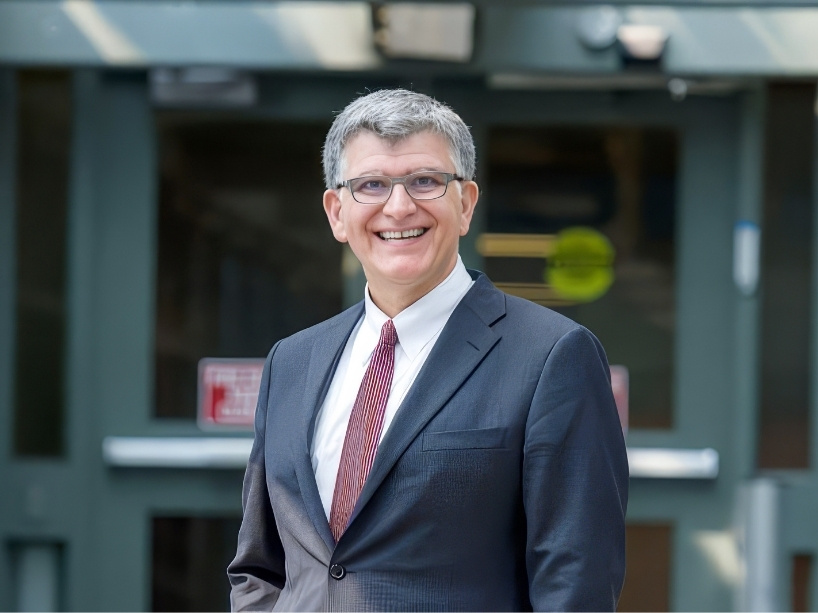
Charles Falzon, Dean of The Creative School at TMU, says the upcoming curriculum change is a "unique development model for what will be a unique education experience." He credits faculty members, including Professor Ramona Pringle, for their dedication and ability to embrace change.