Take action to advance human rights and disability justice
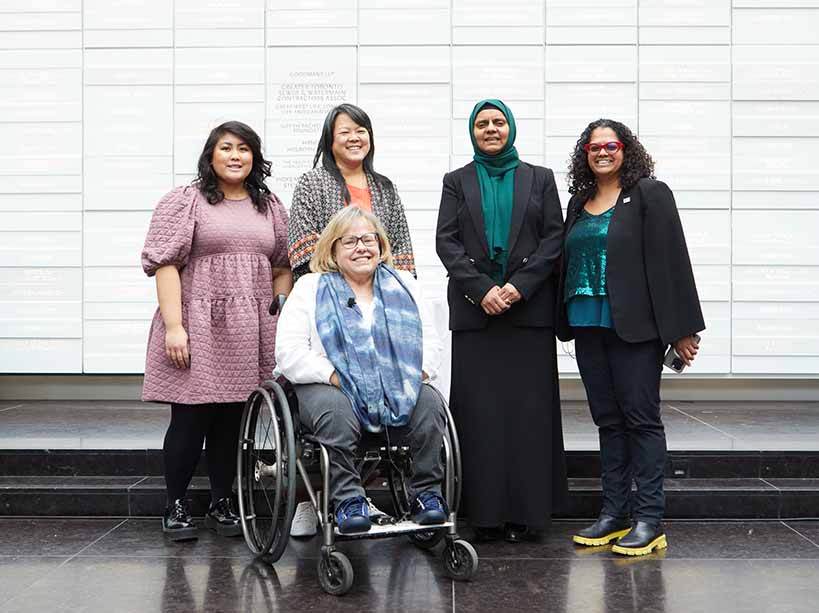
Keynote speaker Rabia Khedr spoke about the profound impacts of systemic racism, poverty and ableism on Canadian society.
How can we better understand the disability experience? What are some strategies to foster collective action and build a more inclusive campus? What are the impacts of systemic racism and ableism on Canadian society?
These are a few of the questions that were addressed at an event last week that recognized both the International Day for Persons with Disabilities (Dec. 3) and Human Rights Day (Dec. 10), commemorating the 75th anniversary of the Universal Declaration of Human Rights.
Organized by the Office of the Vice-President, Equity and Community Inclusion (OVPECI), the event featured keynote speaker Rabia Khedr, national director of Disability without Poverty (external link) and a community organizer in disability justice for more than three decades.
Heather Willis, accessibility coordinator, OVPECI and event co-organizer shared that the event was designed to "empower the TMU community to gain a greater understanding of the disability experience, leaving each person with strategies to foster collective action to contribute to a more inclusive campus."
The event kicked off with a short film about the community at TMU. Across the Universe-City was created by the Employees with Disabilities Community Network (EwDCN) and directed by award-winning filmmaker and TMU alumnus Cyrus Sundar Singh.
“The film captures stories of the lived experiences of employees with disabilities at TMU and challenges viewers to consider their role in creating a more inclusive experience for everyone,” said Yvonne Simpson, curriculum specialist in the Office of the Vice-Provost, Academic and a member of the EwDCN.
“We created this short film with three goals in mind: to educate about the impacts of ableism and the importance of combating its effects; to increase awareness of accessibility and the barriers on campus, as well as how to address them; to empower employees with disabilities to seek out supports available on campus. It aims to ignite community engagement about how accessibility and anti-ableism are a shared responsibility.”
‘Rights come with responsibility’
As an immigrant child, Khedr reflected on how grateful she was for the many freedoms we enjoy in Canada. “We have the right to demand and expect more, and express for more,” she said in her remarks.
She acknowledged that despite the many barriers she faced as a person who is blind, she got an education in Canada, a career, opportunities for community, family and leadership, and most importantly a voice to express her views and opinions freely.
“Language is power – it can give power and take power away when it comes to disability justice, equity and human rights. When we use inclusive language, it fosters that feeling and reality of belonging and inclusion,” she said. “When TMU talks about equity, diversity and inclusion, and brands it as equity and community inclusion, it has begun from that position of fostering belonging – because we’re talking about community; diversity is just a reality around us.”
The goal of equity strategies, Khedr said, should be to establish a just and inclusive system of programs, supports, services and opportunities. This includes fostering spaces where full participation is available, where principles of universal design are applied to ensure equity and accessibility, and accommodation needs are embraced.
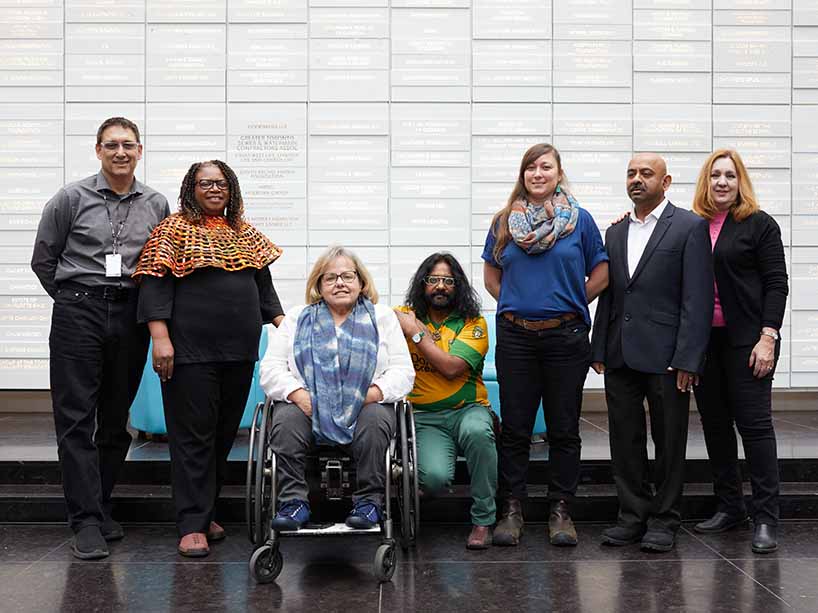
Members of the Employee with Disabilities Community Network inaugurated their short film, Across the Universe-City, highlighting the lived experiences of employees with disabilities, the impacts of ableism and the importance of combating its effects.
Further, Khedr reminded us that the informal opportunities that education and employment provide, such as networking events and celebrations, must also reflect human rights, equity and disability justice. This includes even seemingly small things such as the food served, the seating layout, sound systems and interpretation services.
For example, she shared that “as someone who is blind, a name tag means nothing to me; but when you give me the list of attendees in advance, I can participate fully and can have a list of people I want to meet, converse and network with.”
Steady progress for a better future
In the 75 years since the world signed on to the Universal Declaration of Human Rights, there have been great strides in legislation. The Ontario Human Rights Code was created in 1962, and the Charter of Rights and Freedoms was established in 1982.
“Disability had to be fought and advocated for to be included in the Charter and reflected in the Code,” Khedr said. “Then came the Accessibility for Ontarians with Disability Act, the Convention on the Rights of Persons with Disabilities and the Accessible Canada Act.”
The Canada Disability Benefit has been passed by the government and it has the potential to lift people with disabilities out of poverty. As Khedr highlighted during the event, four out of 10 people living in poverty are disabled and 50 per cent of food bank users are disabled. At the same time, 27 per cent of people in Canada have a disability.
Despite progress in legislation, Khedr questioned whether most people with disabilities really have employment readily available that is accessible and accommodating to their needs, whether they have quality education that includes everybody and gives them full opportunity to excel, and whether they are truly operating in a human rights environment.
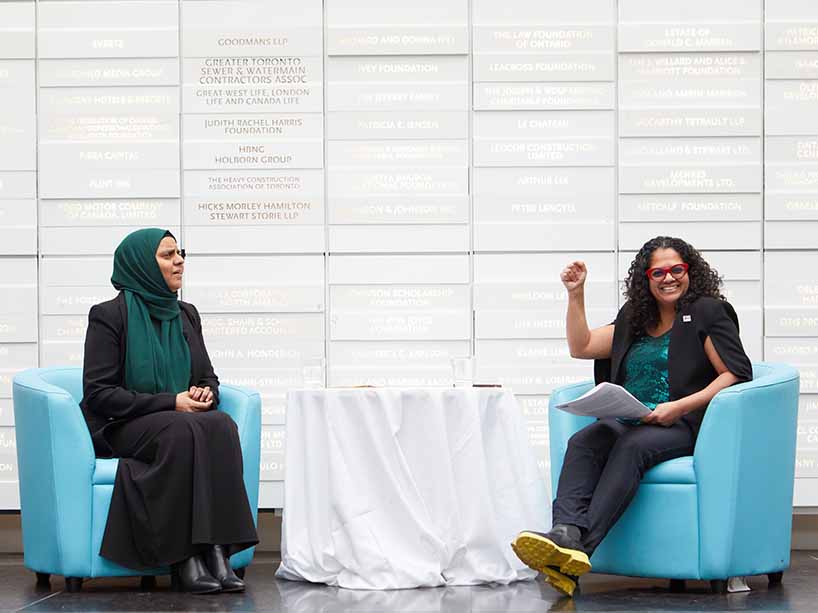
Rabia Khedr (left) with Tanya De Mello (right), TMU’s Vice-President, Equity and Community Inclusion.
“We have a lot of work to do. We made a lot of progress, and then came 2020, when the clock stopped. Disabled people and other marginalized people found themselves further marginalized because the able-bodied, privileged world was disrupted by a pandemic beyond their control,” Khedr said.
“From masking policies that didn’t think about people who are Deaf and need to lip read, to people who might have fear and anxiety, shutting down transit systems, and introducing social distancing measures that guide dogs don’t understand. People were forced to shop online when platforms weren’t accessible to everybody, and work-from-home was introduced as an accommodation and a privilege. Working from home became the norm, because able-bodied people needed it.”
To build a better future, Khedr called for a renewed commitment to recognizing where we came from and where we are going. “Take on the challenge, use your power and privilege, because every one of you has some to use and share. When we build relationships together, we strengthen community, we foster belonging and inclusion, we can change the world.”
To learn more about advancing disability justice and human rights, watch the full event recording.