TMU putting mental health first in education
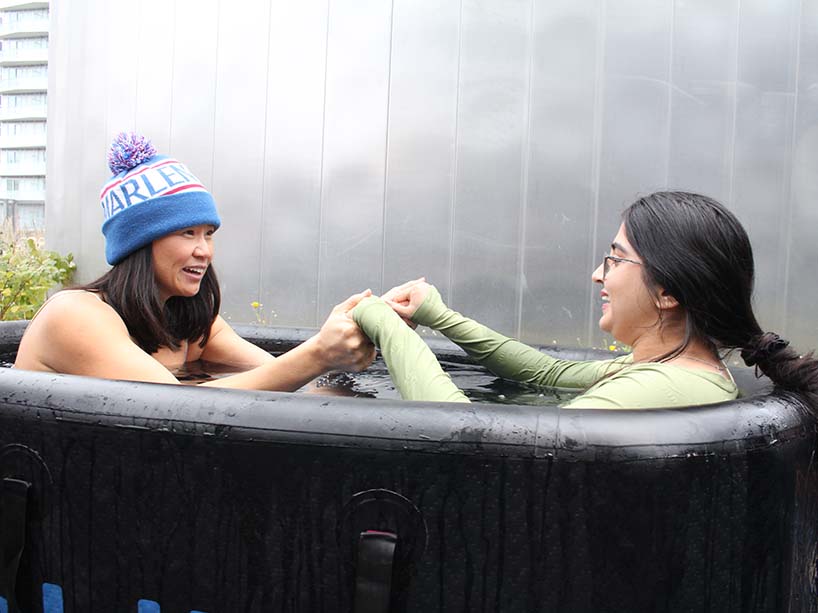
Professor Ellen Choi, left, cheers on a student from her course, Managing Interpersonal Dynamics and Teams, as they complete a two-minute polar plunge. Among many benefits, the exercise helps participants increase their ability to conquer challenging situations. (Photo: Jessica Patterson/TRSM)
When Ysabela David first got into a tub of ice as part of a polar plunge with her business class, her first feeling was shock.
“Every part of my body was screaming at me to jump out,” she said.
But, she didn’t.
Instead, she told herself, “You can do this,” and “You deserve to succeed.”
That, coupled with the support of her professor, her peers, and the cold plunge team, helped David, 20, stay submerged in the ice cold water for two minutes.
The experience was life-changing.
“It made me realize that I was capable of stepping out of my comfort zone in a way I didn’t think was possible – I came out a different person,” she said.
David’s experience was part of an optional cold exposure therapy workshop for students in the course, Interpersonal Dynamics and Teams, taught by Ted Rogers School of Management (TRSM) professor Ellen Choi.
Its purpose? To strengthen resilience, self-control, self-awareness and more.
The experience is part of a new approach to learning across Toronto Metropolitan University -- to incorporate mental health and well-being into the curriculum to strengthen students’ ability to thrive.
Finding comfort outside comfort zone
Choi introduced the cold plunge experience to her students last fall, with the most recent “dip” taking place on October 16 and 17 at TMU's Urban Farm, located on a campus rooftop.
To hold the event, Choi teams up with the wellness company, Unbounded (external link) . She says the icy endeavour helps students develop the ability to persevere in challenging circumstances.
"When we expose ourselves to discomfort on purpose, we increase our tolerance to stress and enhance our ability to adapt.,” said Choi. “Ideally, this experience helps students so that the next time a difficult situation arises, they realize they have the skills to regulate their thoughts, feelings, and behaviour.”
Participating in the plunge provides a range of benefits, including enhanced stress management skills, improved self-control, the ability to empower and engage others, lead positive change, build effective teams and more - all while in a demanding situation.
Choi adds that cold exposure increases dopamine release, “which supports goal-directed behaviour and enhances mood”. It also increases epinephrine (adrenaline) and norepinephrine (noradrenaline), which lifts energy and enhances focus.
The experience is a perfect compliment to a course that Choi says has mental health and wellness learnings “baked in.”
“This course asks individuals to get a better understanding of who they are, their strengths and weaknesses, their self-doubt, and any anxieties they may have so they can be more effective when managing others,” explained Choi.
It’s especially important to address post-pandemic since student social anxiety is high. “So many are reluctant to speak,” she said.
Participating in the polar plunge is one way to break down that wall.
“People come out of the water fired up, hugging and screaming, saying, ‘I didn’t think I could do that.’ It’s such a positive response and an immediate hit of self-efficacy,” she said.
Equipping future leaders
Other courses at TRSM are also embracing the new wellness approach.
One course, Leading for Performance and Wellbeing, was recently incorporated as a core component of the MBA program.
Launched in Fall 2020, the course emphasizes the role leaders play in fostering well-being for their teams and themselves.
“It’s important because, as current and future leaders, these students will be setting the tone for their organizations,” said professor Kristyn Scott, who teaches the class.
She points out that while some workplaces might offer occasional workshops on well-being or mindfulness, one-off sessions may not have lasting power.
“What happens if you take that seminar or session, and then you’re back in the same environment afterward? It goes away quickly if it's not incorporated into the fabric of our daily work lives,” Scott said.
Within the course, students are encouraged to model positive behaviours, which can have a major impact.
“Just saying, 'I need a break right now,’ or just taking five minutes to step outside and feel a cool breeze, or have a cup of tea, it’s really important,” she said.
Scott also highlights the importance of leaders checking in with employees, especially during challenging times.
"Social relationships are important. Knowing that my leader cares enough to check in, or takes my voice into account, these things go a long way,” she said.
“The more we can encourage this thinking among future leaders and current leaders, the better the workplace will be for everyone,” Scott said.

Psychologist Diana Brecher notes that unless a company is “run by robots”, it’s imperative to foster employee well-being in the workplace. (Photo: LinkedIn Sales Solutions/Unsplash)
‘Outside of the box’
One of the key figures of TMU’s new approach is psychologist Diana Brecher, an expert in positive psychology.
Brecher’s teachings are so in-demand, she’s leading a variety of courses across multiple disciplines- from courses in everything from psychology, social science to business, with guest lectures in engineering, nutrition and theatre classes.
At TRSM, Brecher teaches Mental Health and Wellness in the Workplace, an elective in the MBA program, which launched in 2020. (There are two additional courses at TRSM that incorporate well-being - Interpersonal Effectiveness and Teams and another which incorporates mindfulness and self-compassion.)
Brecher praises TRSM for “stepping outside of the box”.
“Businesses are run by people, and I think this recognizes that. It’s an insightful perspective. You know, unless your business is entirely run by robots, you have to attend to the needs of people,” she said.
The course involves students applying principles of positive psychology to their knowledge of the workplace.
“We ask things like, ‘What are the conditions of the highest productivity? How do you cultivate a growth mindset?’” she said.
Brecher begins and ends her classes with a mindfulness exercise.
“I always give the option to opt out - but it’s really incredible how that changes. After a two or three minute meditation, there is this settling that is quite affable. It’s not for everyone, but for many, it becomes a tool they can use in many different ways in their lives.”

Experts say that giving employees the flexibility to work where they are most productive has many benefits. (Photo: Anete Lusina/Unsplash)
‘Put yourself first’
Brecher is also the mastermind behind the rapidly expanding ThriveTMU – a free, four-week resilience program that has been taught “several hundred times” to TMU students, faculty and staff.
Ensuring students can access these learnings has endless benefits, she said.
“By learning more about mental health and thriving as part of their studies, students are more likely to feel empowered to prevent significant distress, bounce back from setbacks faster, and with more hope because of what they have learned,” she said.
Additionally, she notes that learning it in the classroom gives the topic more credibility and access to those who might not choose to pursue this information, or can't make the time for it.
“If it’s in the classroom, they have access,” Brecher said.
For students like David, it’s essential learning.
“We need to learn about mental health and wellbeing, because it has a direct effect on your level of productivity, your ability to work, and to interact with people,” David said. “Yes, business is about the hustle, but you also have to put yourself first.”
Related stories:
- New, free video game to boost mental health in kids, teens based on TMU program
- New, free digital tool by Zone startup helps refugees, immigrants with PTSD
- Polar plunge par for the course for Human Management Resource students