Indigenous-led politics program quietly changes lives for 20 years
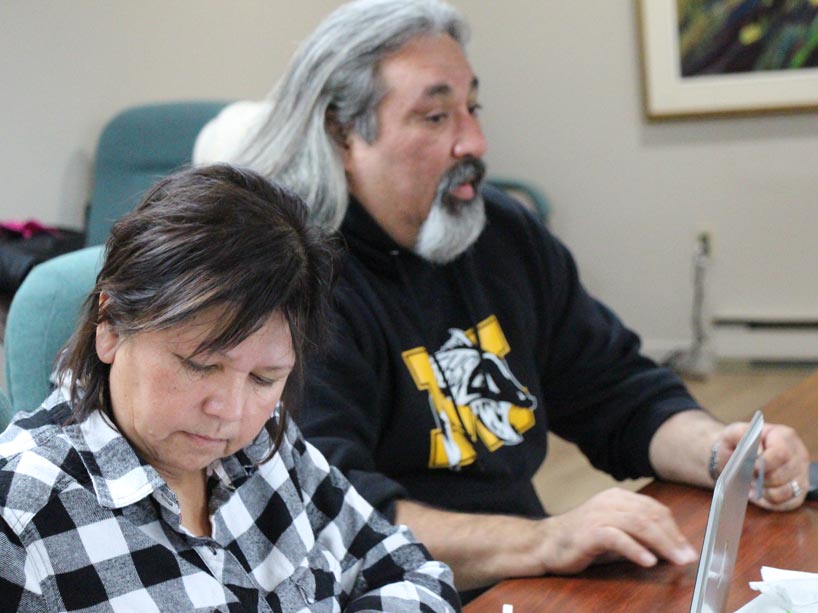
Partnership between Ryerson and the First Nations Technical Institute (FNTI) lets students earn a bachelor of arts in public administration and governance with an Indigenous lens while working full time. Photo provided by FNTI.
She got lost on her first day of class.
“It was nerve-wracking!” laughs Nikki van Oirschot of Caldwell First Nation, who remembers driving into downtown Toronto from her home in Appin, Ontario. The traffic was a nightmare.
Van Oirschot is now in her third year of the bachelor of arts in public administration and governance, jointly taught by Ryerson’s Department of Politics & Public Administration and the First Nations Technical Institute (FNTI) in Tyendinaga.
The partnership provides Indigenous students training and academic accreditation to become public administrators and leaders in First Nations communities. Students can work full time while earning their degree by attending four-day sessions on campus four times a year at Ryerson, and twice a year at FNTI, until they complete each level of the program. Since it launched in 1999, the joint bachelor of arts program has graduated 250 students from across the country.
Supportive networks make a difference
Van Oirschot likes that her instructors – most of whom are themselves Indigenous – incorporate traditional ways of learning and teaching, such as holding sharing circles facilitated by cultural advisors prior to and during classes. Instructors also bring an Indigenous lens and political experience to class. She’s also made lifelong friendships with her peers, who come from First Nation communities across Ontario and as far away as Northern Canada, as well as expanded her professional network.
“I really value the partnership and opportunity that’s afforded to Indigenous people to take this program,” she says.
Van Oirschot has been applying knowledge she’s learned in the program to her role as director of operations for Caldwell First Nation. The Indigenous perspective brought to every class ensures people who work in their communities, like her, find the content both engaging and relevant.
Many graduates return to teach. Joe Tom Sayers of Batchewana First Nation started the FNTI-Ryerson program in 2013 and went on to receive the Ryerson Gold Medal when he graduated in 2018. This past spring he began teaching politics to students just like van Oirschot. Since graduating, Sayers has gone on to earn a master’s in public administration from Queen’s University and will start his Ph.D. at York in the fall – all while working as Indigenous engagement director for Investigative Solutions Network, Inc.
“I really value the partnership and opportunity that’s afforded to Indigenous people to take this program”
Sayers appreciates the seamless integration between FNTI and Ryerson from enrolment to online course delivery, to interacting with administrators from both schools.
“They really struck an awesome balance between offering a mainstream university experience as well as being grounded in Indigenous communities and Indigenous cultures. For me, it really set the standard that other institutes can emulate,” he says.
This is exactly the kind of feedback that Adam Hopkins (Lunaapeew and Anishnaabe), vice-president of Enrolment Management and Student Services at FNTI, hopes to hear. Reflecting on the program’s success over 20 years, he sees FNTI taking the experiences gained through the partnership to soon have the program accredited.
“Ryerson has always been an excellent organization to work with. I see them as being very learner-centred. I wish I had taken the program myself back in the day,” he says.
Program’s success signals progress
Professor Christopher Gore, chair of the Department of Politics & Public Administration, notes that many students who’ve completed the program are now mentors and teachers in the program. While he’s adamant that institutions can always do better to support Indigenous students, Gore believes the long-standing collaboration between FNTI and Ryerson shows the value of listening to the communities you serve and the need to build and revise a curriculum that reflects their realities.
“The partnership is important because it challenges the university and our department to think carefully and critically about what a respectful and responsive collaboration with Indigenous communities, institutions and students must look like,” says Gore.
The Faculty of Arts has hired 11 Indigenous scholars in the past three years – five of whom will join Ryerson starting July 1, 2020.
“When the curriculum and instructors connect the material with the historic and present lived experiences of Indigenous communities, students thrive,” Gore adds.
With two years left to complete her program, van Oirschot is looking forward to graduating with an accredited bachelor's degree from Ryerson. As a single mother of two teenagers and working full time, she didn’t take the decision to return to school lightly. She knows the education will help her advance her career in Indigenous governance and administration, as well as support her family.
“Sometimes you want to throw in the towel and say ‘I have so many commitments on my plate, maybe I should just take a break from my education.’ But when you see that the end game is there – that there is success at the end of this – it encourages you to keep going,” van Oirschot says.