Student-led monthly market provides more than food
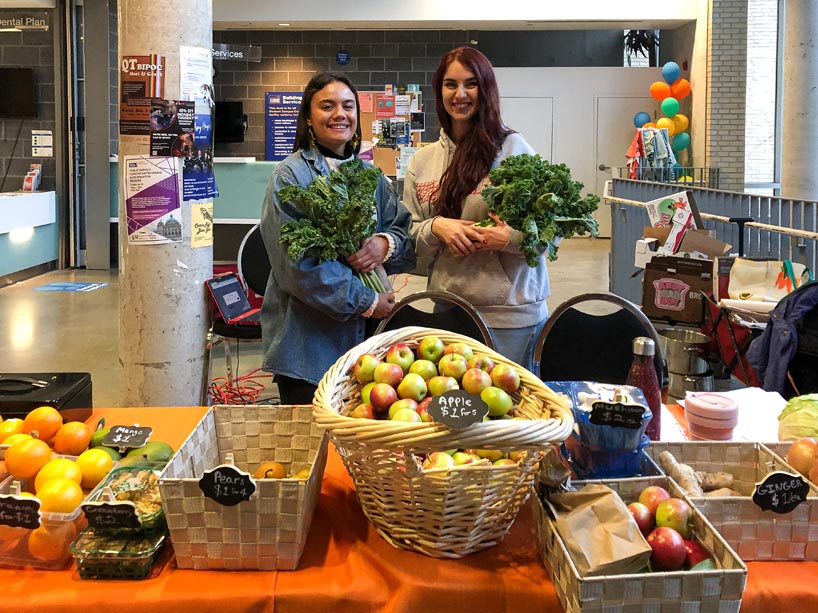
From left: Kaitlin Rizarri and Maria Jude had a full table of goodies for sale at the December 4 Good Food Market.
Sometimes access to food can be taken for granted, especially when you live in an urban centre surrounded by fast food restaurants.
That’s one of the reasons the Good Food Market (external link) (GFM) was started at Ryerson – to give students easier access to healthy, affordable food. Fifth-year students Maria Jude, food and nutrition, and Kaitlin Rizarri, law and business, are co-leads of Ryerson’s Good Food Market, a collaborative initiative between several student-led groups, including the Ryerson Students’ for Food Security (external link) (which Jude co-founded with Kimberly Vaz, a social work graduate) and CESAR.
“It’s a market for students by students,” Jude said. “We advocate for food sovereignty on campus, focusing on local and healthier food options for sale.”
“Ryerson is located in a bit of a food swamp with so many fast food and restaurant options around us,” Rizarri adds, “the market provides a comfortable, alternative option for students.”
The Good Food Market launched in April 2019 with monthly markets at the Student Campus Centre selling high-quality, culturally appropriate, affordable food, including fresh fruits and vegetables. Jude and Rizarri, having experienced food insecurity themselves, wanted to dismantle the narrative of the “starving student” – the normalized image of students eating $1 ramen noodles every day or skipping meals in order to afford textbooks and tuition.
La Via Campesina (external link) , a global peasant’s movement, defines food sovereignty (external link) “as the right of peoples to healthy and culturally appropriate food produced through ecologically sound and sustainable methods, and their right to define their own food and agriculture systems.”
Rizarri says there is still a stigma attached to using a food bank and the function of food banks, although a helpful resource, doesn’t allow for users to have agency over the choice of foods available.
“The market also brings life to a community that can be sometimes isolating. It’s heartwarming,” Rizarri said.
A variety of choice
Bitter melon, Jamaican sweet potato, bok choy, onions, persimmons, oranges, sourdough bread, apples, pears and broccoli are some of the items available for sale. On selected days, like their most recent market on December 4, they also sell prepared food such as homemade soup
Food is provided by Food Share (external link) , a non-profit that challenges the barriers to food justice and access. Food Share products are fresh from local farmers and bakeries, sold at the lowest cost. The market has a sliding scale for prices – faculty, staff and community members who can afford to pay a little more help keep the market running, while pay what you can applies to those who need it.
Besides cash, the market also accepts credit, debit and Apple pay, and the use of reusable bags is strongly encouraged. They’ve sold out at almost every market.
In addition to Jude and Rizarri, the market is run by part-time CESAR and Meal Exchange employees and volunteers. Meal Exchange (external link) is a charitable organization that offers national programs to transform food access on campuses. Its funding has allowed the Good Food Market to exist but with funding running out this month, both Jude and Rizarri are keen to find another source of permanent funding before they graduate in June 2020.
Next markets will be on January 15, February 15 and March 5 – all at the Student Campus Centre. Students interested in volunteering for the GFM, can email gfm@mycesar.ca.
For more information on food security, the Office of the Vice-President, Research and Innovation published an online newsletter on food research.
This is one of a series of stories on students, faculty, staff and alumni giving back to their communities.
Related:
Ryerson grad gives back with unique sock vending machine
Office of the Vice-President, Research and Innovation newsletter on food research