Nothing is taboo on this app
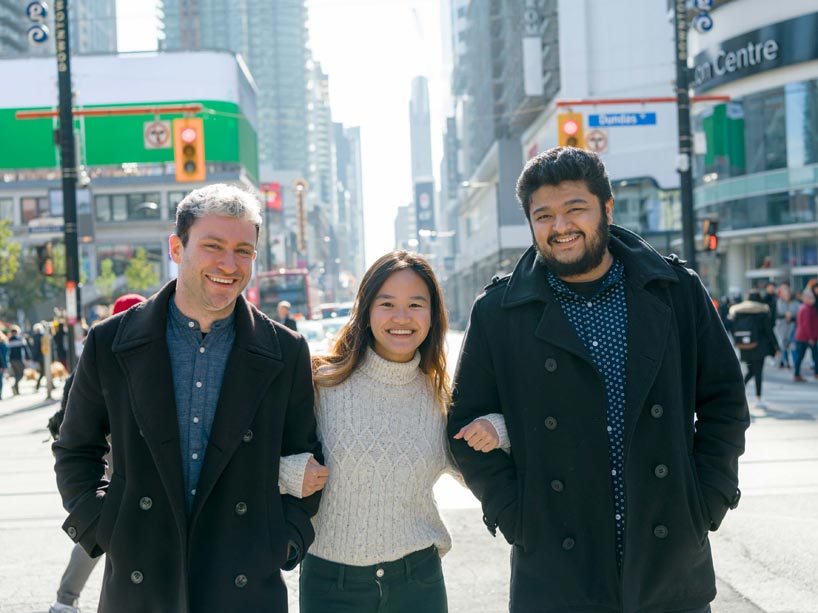
Photo: Students developed the TabooZapp as part of the FCAD Creative Impact Supercourse. Now they work full-time. From left: Brock Dishart, research and innovation coordinator; Linh Tran, user experience and communications coordinator and Robin Ghosh, head of content and video production. Photo: Clifton Li.
Sex… bullying… mental health… puberty… abuse… religious, political, and gender identity… it sounds like a list of topics you’re not supposed to bring to the dinner table. But a new Ryerson-incubated app wants users to get comfortable with the uncomfortable.
TabooZapp (external link) , a new, youth-focused digital movement based at Ryerson’s Paradox Lab, uses storytelling to aim straight at society’s taboos. The app curates original content for a menu of issues, with real people sharing personal stories. Its features include “Hot Topics,” a venue for open discussion about life’s struggles, “Project Me,” a curated toolkit of information and resources, and “Inspire Me,” where well-known influencers share their own experiences of overcoming adversity.
“The whole point is to show people that a) they’re not alone, b) help is out there and there’s nothing wrong with being vulnerable,” says Vanessa Arelle, founder and CEO of the app.
“Let’s get rid of cultural, social, and systemic taboos that are outdated and pointless. There’s no reason why they should exist. I’m sure that at a certain time in history they were useful. But I suspect that when many of them became part of everyday life, there probably wasn’t even electricity let alone the Internet and digital devices. There’s isn’t a reason for most of them anymore. I think that an educated, empowered next generation is the objective.”
To reach students, Arelle knew she would have to work with students. But how did a social entrepreneur based in London, England find her way to Ryerson? It all came from a chance encounter with Hossein Rahnama, director of the Paradox Lab, the FCAD-MIT partnered lab located in the DMZ. Rahnama and Arelle brought TabooZapp to the FCAD Creative Impact Supercourse, the annual initiative where multidisciplinary student teams design solutions for real-world organizations.
Arelle devised the framework, and a team of Ryerson students developed the technology by complementing and elevating a Salesforce employee volunteering and giving program designed app. “I flew out in late January to say, ‘I need an Empathy Meter!’” remembers Arelle. “They said, ‘Okay, great!’ There was very little communication—they did it all on their own. I was blown away.”
The Empathy Meter, which keeps track of interaction through a #digitalhug, sharing stories, making videos or simply being an active member of the community is a unique alternative to the “likes” and “loves” of most social media platforms as it measures giving not receiving. But the Ryerson students went even further: they designed a Mood Tracker, which allows users to track their mood from day to day, receive personalized content based on their mood, and identify when users may need a little more support (the app provides links to resources such local support help lines).
“The result came from a diverse group of people,” says Linh Tran, media production (master’s) ’18, who now works full-time as the app’s user experience and communications coordinator. “We worked with undergrad students, graduate students, professors—everyone came from diverse academic, social, and racial backgrounds. That has helped, because we’re trying to bridge a diverse group of young people with different identities.”
The creative process was also a hands-on educational experience. “We helped each other out and did different roles,” says Brock Dishart, master of digital media ’18, who is the research and innovation coordinator. “We’re doing everything, and putting on different hats has been a learning experience.”
Working with TabooZapp “has allowed us to talk to students of different backgrounds and to shape the community through their experiences and stories,” says Robin Ghosh, media production (master’s) ’18, head of content and video production.
Working with Ryerson students encouraged Arelle to make Toronto the home base of TabooZapp. The app launched first in Canada instead of its original plan to launch in the U.K.
“At the end of the day, I’m too old for this—I don’t know what you guys want to hear,” says Arelle, with a laugh. “When the opportunity came up for actual students to look at it—they’re able to relate to what it’s like to be in university. It’s about authenticity, and the students bring a unique innovative spirit which is evident in what they’ve done.”
Available on Android and iOS, download TabooZapp, at www.taboozapp.com (external link) .