From Toronto to Paris by Hyperloop
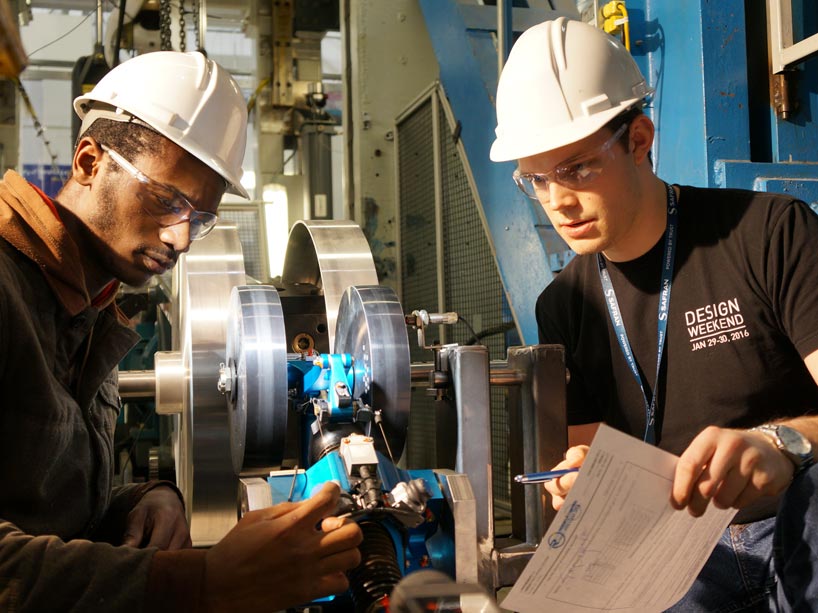
Photo: Graeme Klim (right) was a founding member of the Ryerson International Hyperloop Team.
A founding member of the Ryerson International Hyperloop Team (external link) is bringing that innovative thinking to Paris in a full-time position at Safran Landing Systems (external link) . And according to Graeme Klim (aerospace engineering ’15, master of applied science ’17), the road to Paris began almost as soon as he came to Ryerson in 2010.
A self-described “quiet and reserved” student, he stepped out of his comfort zone by joining the Ryerson Aerospace Course Union. “I got the courage to sign up and make a speech, and I think that’s where my trajectory started and got me to where I am today,” he says. This encouraged him to pursue working as a residence advisor in the International Living and Learning Centre, and then as a residence Academic Link for Engineering and Architectural Science students.
“All of that brought me to where I am today. Ryerson helped build my young-leadership portfolio. These are things I never could have done at high school, and they really helped prepare me for my eventual interview in spring 2013 to join Safran.”
He earned a 16-month work placement at Safran Landing Systems in Ajax as a design and analysis engineering intern. Here, he built the knowledge needed of aircraft landing systems that would be essential for his future: Ryerson’s International Hyperloop Team started in summer 2015, with Klim as a founding member. The team developed an innovative wheel-deployment technology that could make Elon Musk’s proposed high-speed tube-based transit system safer. The team won the Subsystem Innovation Award at the 2016 SpaceX Hyperloop Pod Competition.
In Paris, Klim works as an ingénieur d'etudes transmission, specializing in a technology called “electric taxiing (external link) ”—equipping landing gear with a motor inside of the wheel that can help taxi the aircraft. “Normally when an aircraft is on the ground it’s being moved by either a tow-truck or an aircraft taxi, or it’s using its engine to move around, which wastes a lot of fuel. What this does is use battery power stored in the aircraft to move it around. You save money and reduce emissions for the airline operators.”
In an exciting development, he is also the technical lead on a new Hyperloop project. “Since I arrived in France last May, everyone knew me as the Hyperloop guy, and I was very obsessed with the idea of continuing with work on the Hyperloop,” he says. He is working with five student interns, three of them Ryerson aerospace undergraduate students who have come to Paris for the summer: Yash Parikh, Francis Picotte, and Andrew Ellis. “They’ve been great—and for me, they’re representing Ryerson very well,” says Klim.
Looking back, Klim says, “What I’ve learned over the last few years working on the Hyperloop project and working at Safran is, you need to find a job that you love, but you also need to surround yourself with managers, mentors, and faculty advisors who support your cause. With that, the sky’s the limit—evident by the success we had with the Hyperloop team at Ryerson. We were able to actually bring Hyperloop operations to a company that traditionally focuses just on aircrafts. I couldn’t have done any of that without support.”
*
Related story: