An industry-driven, academic approach to energy
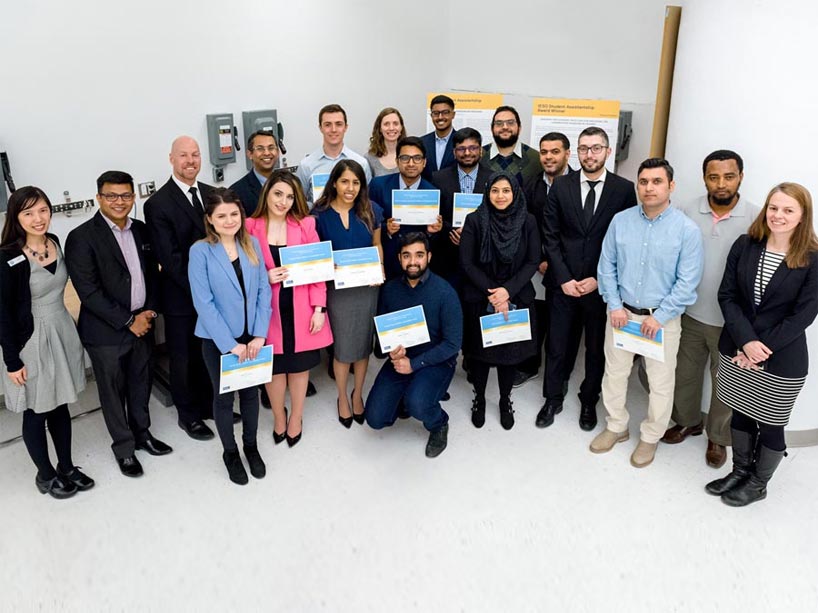
Photo: Ryerson graduate and undergraduate students at the Centre for Urban Energy’s Student Awards. Photo by Clifton Li.
Industry-driven but academic-led, the Centre for Urban Energy’s Student Awards supports innovative solutions with real-world potential for the energy industry.
Ryerson graduate and undergraduate students identified and researched a problem in the energy sector, and then demonstrated results, with sponsorship from a major public or private energy company: IESO, Toronto Hydro, and Enwave Energy Corporation. The awards were presented at a ceremony at CUE on April 5.
“We want to prepare students so that they’re able to solve big energy challenges, and in service of this, we want to augment the foundational theory they learn in the classroom,” said Jessie Ma, senior research fellow at CUE. “It’s very important to learn the first principles, but we want to train them so they’re able to apply it to real-world problems.”
The awards fit into CUE’s mandate of being industry-driven but academic-led. “Industry defines the problems in urban energy that they want our help in solving, and then we take an academic approach, bringing all the tools and knowledge that you might not find from consulting companies,” said Ma. “We bring those two strands together to solve the big urban energy challenges.”
Recipients of the Toronto Hydro Corporate Student Award, Venkatesh Muthusamy (MASc, aerospace engineering) and his team developed a tool to estimate the remaining useful life and state-of-health of batteries. “You get a car with a new battery and you use it for a year, and based on that information, we can predict, ‘At this rate, the battery will be useless in seven years,’” said Muthusamy. “The idea was to establish that as a student team, we can prove this with our resources. With funding from CUE, we have now bought batteries, and our plan is to take it from the algorithm level to a real, live system. … We’re planning to buy the hardware so we can get this battery running and get some data on it, and the next step will be based on that.”
“For my master’s research in aerospace, I was already working on these types of problems,” he added. “I predicted the remaining useful life of a spacecraft system, or an aircraft engine—those types of systems. Based on that, I’ve tried to apply the same type of algorithm to lithium ion batteries—the go-to option for energy storage systems.”
Maimoona Naeem (MASc, electrical and computer engineering) was one of the recipients of the CUE-IESO Student Assistantship Award. Naeem worked with IESO (Independent Electricity System Operator) to analyze the complexities of energy conservation and demand. Her research analyzed the economic tests being used for deploying conservation programs. She also performed risk assessment for natural gas delivery in Ontario; looked for correlation of weather conditions with the prices of natural gas and electricity; and studied technologies that could help reduce peak demand. Naeem worked with Ma, who is also an IESO distinguished research fellow, on the integrated delivery of electricity, natural gas, and water conservation in Ontario.
When asked about the importance of the Student Awards, Jessie Ma said the research opportunities “support students financially, and provide a unique experience they wouldn’t get in a purely academic environment.
“They’re also important for the industry sponsors: they’re supporting work that can help them in the future. We know the energy landscape is changing, faster than it has in recent memory. Our industry partners recognize that, and this is one way they can do something to prepare for what might be coming.”