For Linying Dong, it's all about the students
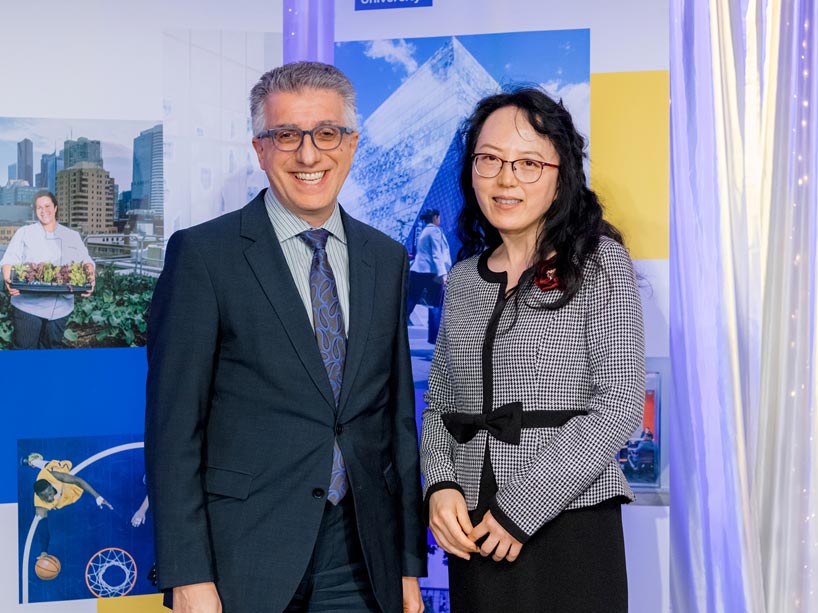
Photo: Ryerson Provost Michael Benarroch with TRSM professor Linying Dong at Ryerson Awards Night on March 28. Dong received the Provost’s Experiential Teaching Award. Photo by Clifton Li.
Linying Dong has taught at Ryerson since 2004, but though she has become a respected and honoured faculty member at the Ted Rogers School of Management, she has never lost sight of an underlying truth: “I feel this job really is a privilege.”
At TRSM’s School of Information Technology Management, she is the student-faculty advisor, and course-coordinator of the capstone project. “To be able to stand in front of a classroom and teach something valuable and relevant is extraordinary. I do value that opportunity, and I really appreciate that I’ve been given that opportunity. It’s where I started to find different ways to inspire students.”
At Ryerson Awards Night on March 28, Dong was recognized with two awards for her service to the university: the Provost’s Experiential Teaching Award and a Dean’s Service Award from TRSM. The award citations noted that she has developed and improved curriculum, introduced innovative teaching methods, and “worked tirelessly to improve the student experience.” Or, as she puts it: “When I develop course materials, I think from the students’ perspective. How is the material relevant to them? Why they would learn the material? What tools would be useful?”
This means translating complicated concepts through accessible strategies. She recalls a time early in her career when she set up a classroom debate competition. “At the time, Walmart was planning to expand in Canada, and I was teaching an upper-level strategy class where one of the key elements was industry analysis. I wanted them to be able to relate that framework to an actual example. So I asked them, ‘If you were Loblaw, how would you react?’ Immediately, they could see the framework.”
In another early class, she was tasked with explaining system analysis and designs. “I knew ‘system analysis and designs’ was foreign to them, and gathering system requirements means nothing to them. So, I did an experiment: I picked two students and had them ask each other what they wanted for a meal. Even though they exchanged simple questions, the information communicated involved requirements. That’s one way of illustrating concepts.”
For the past decade, she has co-ordinated the Ted Rogers School Information Technology Management capstone course, which connects upper-year TRSM students with external clients for an eight-month internship. Student groups learn the company from the inside, gathering and presenting information on how a company can improve an aspect of its operations. Since becoming the co-ordinator, Dong has both broadened and better defined the course, introducing concepts like process improvement and change management into the students’ evaluations. She has also introduced Wrike, an online platform where students can more easily manage and present their work.
“I have 90, sometimes over 100 students, and that means 17 projects with 17 different clients,” said Dong. “It’s very difficult to keep track of their activities. With Wrike, I can see all they’ve done in the past week and what they’re planning to do in the coming week. I can see their assessment of the work performed.
“For the students, it’s a project management tool, and a way for each team member to be accountable to each other. They all have to allocate their work, and they all have to do something for their project. When you’re working for a client, you’re working together for the client, and it’s important that you have a cohesive group.”
When asked about the Provost’s Experiential Teaching Award, Dong returned to that underlying truth. “The award is great, but it represents things I did in the past. It’s a recognition for my efforts, but it doesn’t mean I’m going to do well in the future. I’m driven to keep improving myself, because I have students in my heart. I really want to make the courses I teach valuable experiences to them.”
For more information on Ryerson recognition and awards, go to https://www.torontomu.ca/recognition-awards/.