What is Canada’s role in the world?
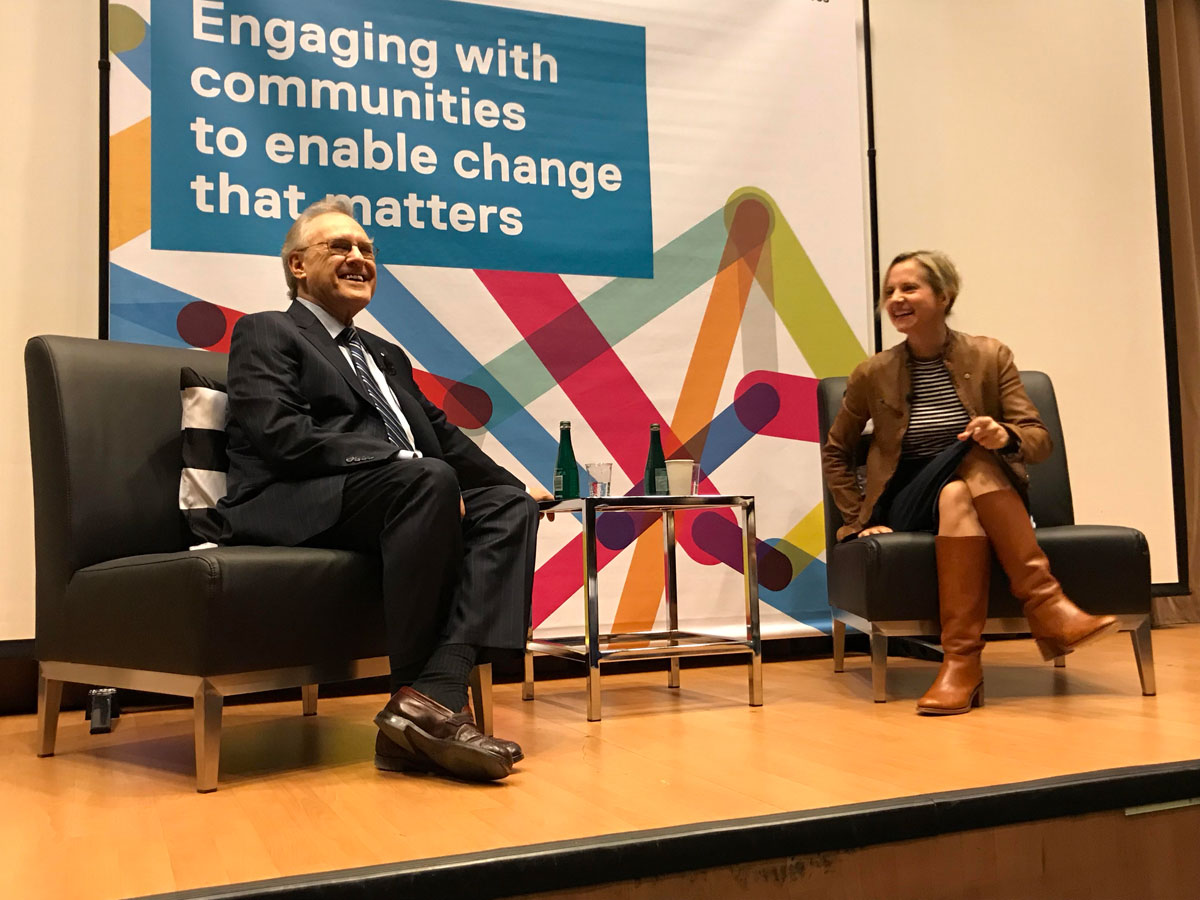
Photo: Ryerson professor of distinction Stephen Lewis interviewed War Child founder Samantha Nutt as part of the Faculty of Community Services’ #FCSinAction series.
As the world undergoes the worst refugee crisis since the Second World War; as the United Nations struggles to respond to genocides in South Sudan, Central Africa, Yemen, and Myanmar; as war-torn countries like Iraq and Afghanistan are on the verge of collapse; as climate change threatens to cause mass migration; and as foreign aid from western nations continues to dry up, humanitarians and activists might find themselves asking: Is there room for hope?
On November 27, Ryerson professor of distinction Stephen Lewis posed this question to humanitarian Samantha Nutt as part of the #FCSinAction lecture series at the Ryerson Library held by the Faculty of Community Services. Nutt replied, “When I lose hope in the very institutions that have been created to try to prevent and mitigate that kind of atrocity, I offset that by doubling down on the alternatives.”
Nutt is founder of War Child Canada (external link) and War Child USA—charities that have worked with children and families in crisis centres from Iraq to Afghanistan to Somalia to Darfur. The charities focus not on aid (i.e. food, water, shelter), but rather on long-term strategies to disrupt cycles of injustice and poverty. “What we do is very complicated,” said Nutt. “It is holistic, it is integrated, it is community-based. … And with 98 per cent of our staff being local, we believe very much in the primacy of that approach to international development.”
Nutt discussed several of War Child’s initiatives. In Afghanistan, War Child is a registered law firm, training lawyers and paralegals to focus on women charged with “moral crimes.” Those charged have included women who refuse to marry their rapists, or who have been the victims of sex trafficking. “Our job is to be on the front lines: to go into the prisons, bring those cases forward, defend those women,” said Nutt. In the last year and a half, advocacy from War Child lawyers has led to the release of more than 1,800 women.
In environments where children have been illegally trafficked as combatants and slaves, reintegration into the education system can be challenging, leading to a lifetime of poverty. War Child has developed accelerated learning programs, tailored to different parts of the world, to help kids catch up to their grade level. “You cannot talk about the health and well-being of children, and you cannot talk about disrupting the drivers of violence without addressing poverty,” said Nutt.
In some areas in eastern Congo, rape is so pervasive that women are not allowed to attend school for fear of being assaulted en route. Working with community-based organizations and Congolese educators and global experts on accelerated catch-up learning, War Child created a first program of its kind: distance-based radio learning. “It’s all tied to the Congolese curriculum. It goes out over radio and we have local teaching assistants who we’ve trained who are deployed to these communities. … We had over 90 per cent of those girls who actually matriculated.” Nutt added that the matriculation rate sends “a clear message of defiance: ‘You don’t get to take this from us.’”
Nutt asked the audience to consider the broader implications of some of the more popular modes of charity. She took aim at the industry of used-clothing donation (“The loss of hundreds of thousands of textile jobs in Africa can be directly linked to the trade and sale of used clothing that originates on our side of the world”), and the phenomenon of “voluntourism”: “The hyper-affectionate nature of toddlers in those environments is a symptom of their repeated trauma. They have a revolving door of foreigners, so it makes these toddlers become hyper-affectionate. Then we come back saying how much these kids really appreciate our 15-year-old volunteer labour … but who’s benefitting the most from that transaction?”
Nutt also accused Canada of complacency, and lacking an activist, internationalist foreign policy since the end of Lloyd Axworthy’s tenure as foreign affairs minister in 2000. “We have effectively been languishing in terms of celebrating what it is that we believe we represent based on the historical record that is actually quite disconnected from the way that we are perceived throughout the world at this moment.
“If you spend any time in Africa and you look at Canada’s reputation and the ways in which it has been tarnished as a result of the activities of some of our mining companies throughout the world. ... If you look at the fact that we did not sign the Arms Trade Treaty along with Russia and China and North Korea … but the fact that Canada missed the boat on that, and then argued at the time that we had rigorous enough policies in place, and then had a $15 billion arms deal with Saudi Arabia, these kinds of nascent hypocrisies that exist in our foreign policy are part of what’s creating a very confusing message about what Canada is and what we represent.”
For a full video recording of the event, visit Ryecast.