What is the legacy of the Centennial Projects?
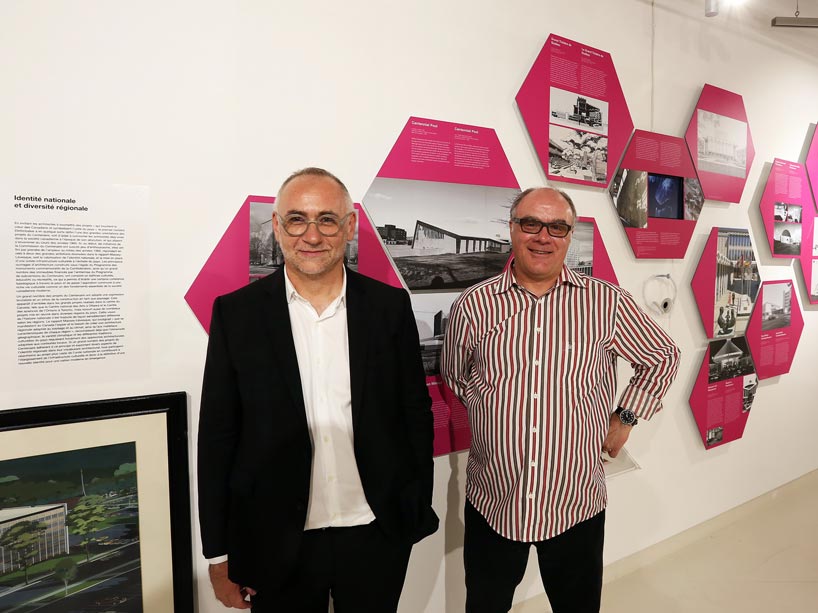
Photo: Ryerson architectural science Professors Colin Ripley (left) and Marco Polo curated “Architecture and National Identity: The Centennial Projects 50 Years On,” on view at the Paul H. Cocker Gallery until November 10. Photo by Yvonne Bambrick.
From 1964 to 1970, as Canada celebrated the 100th anniversary of Confederation, the federal government embarked on an ambitious project to define Canada’s identity through architecture. Fifty years later, the Department of Architectural Science looks back on this unique moment in Canadian history that brought forth 2,300 projects including 860 buildings—many of them still in use.
In Architecture and National Identity: The Centennial Projects 50 Years On, Ryerson architectural science Professors Marco Polo and Colin Ripley curate 21 of the most important projects, divided into three themes: Building the New; Brutalism and Landscape; and National Identity and Regional Difference. Though these structures (including Ottawa’s National Arts Centre, the Ontario Science Centre) were built to celebrate Canada’s centennial, the architects were aiming for the future.
“One of the key characteristics of these projects is that even though they were built to commemorate a centennial anniversary, they were more forward-looking than they were nostalgic,” said Marco Polo. “They were very much about the future of the country. If you look at the Calgary Planetarium and the Vancouver Planetarium, architecturally they’re quite distinct, but they’re both clearly about this kind of space-age idea of architecture.”
Many of the buildings were built in the Brutalist style that had grown popular in postwar Europe. The style emerged from the architect Le Corbusier’s term “béton brut” (raw concrete), which moved away from the idea in his early career of the wall as just a screen, hung off a structural frame – literally, a curtain wall. “In his later work, Le Corbusier used concrete do create walls that go right down to the ground, and metaphorically become part of the ground,” said Colin Ripley. “You can see how that ties into the idea of landscape, and that’s how brutalism gets used in Canada.”
In Britain, Brutalism was associated with the rise of the welfare state—the idea that public facilities were built for everybody, not just the elites. Brutalism in this era was also closely linked to the concept of “megastructuralism,” which looked as projects not as single buildings but as large collections of objects connected by an infrastructure. The Fathers of Confederation Buildings in Charlottetown contained a theatre, art gallery, library, and a series of connecting underground public spaces.
Through photographs, sketches, didactic panels, and models, the exhibition shows how the buildings both transformed and were informed by their surrounding landscapes, and how the architecture could vary subtly across the country. In Ontario, the Brutalist vocabulary is remarkably consistent; in the Maritimes, Brutalism cedes in favour of more orthodox steel-and-glass Modernism; the Grand Théâtre de Québec’s complex melding of Brutalism with Quebec’s local identity.
“One of the things the program made clear was how difficult it is to establish a national identity in a place like Canada, and how little impact architecture can have on that in the end, in a place as big as this country,” said Ripley.
Fifty years on, the legacy of the Centennial Projects is uncertain. “Many of the buildings have endured because they are actually well-liked,” said Polo. “That’s not true of all of them, and it’s not necessarily true because of their architecture. In many cases, they’re well-loved because of what they offer programmatically.”
Is Brutalism out of fashion? “It’s not so much that Brutalism is out of fashion now—it’s that it never was in fashion,” said Polo. “Certainly never with the public. Right now, brutalism is extremely fashionable among architecture students, and it’s been rehabilitated in architecture journals. But for the public it’s never been well-loved, and that’s one reason why these buildings are not safe from radical transformation even if they’re well-used.” The National Arts Centre’s recent renovation radically transformed the gallery from a Brutalist concrete hub into a glassy transparent structure.
“In some ways, this architecture may be more successful at representing a certain moment rather than a national identity,” said Polo.
“Architecture and National Identity: The Centennial Projects 50 Years On” is on view at the Paul H. Cocker Gallery in the architecture building (325 Church Street) until November 10. Visiting hours are 9 a.m. to 5 p.m. Monday to Thursday, 9 a.m. to 4:30 p.m. on Friday. For more information visit the Department of Architectural Science.