Flavia Allajbeu (BSW '25) wins the Social Work Education Journal’s Student Essay Competition
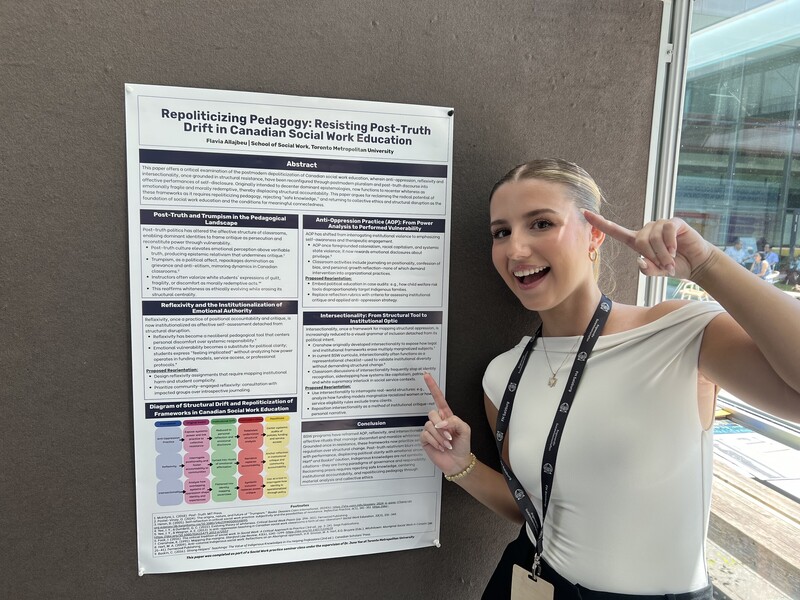
TMU alumna Flavia Allajbeu (Social Work ’25) placed first in the Social Work Education journal’s Student Essay Competition, announced at European Conference on Social Work Education (external link) , held in Salzburg, Austria in June 2025.
Representing Toronto Metropolitan University, Allajbeu was an upper-year social work student — and the only undergraduate from North America invited to present at the conference.
Her winning essay — submitted as an assignment for a 4th year Bachelor of Social Work Integrative Practice Seminar and developed with the guidance of professor Dr. June Yee — was titled "Repoliticizing Pedagogy: Resisting Post-Truth Drift in Canadian Social Work Education (external link) ".
Allajbeu presented the essay and a research poster of her work at the conference. The essay has since been published in the highly regarded, international, peer-reviewed journal Social Work Education — a rare accomplishment for a student at the undergraduate level.
Allajbeu's winning essay, summed up
“Social work education has moved away from discussing core issues like power and politics, becoming more performative in practice. When frameworks such as anti-oppression and intersectionality turn into classroom checkboxes, they lose meaning. For real change, social work must return to critical, honest, and politically grounded teaching.”
After graduating, Allajbeu began law studies at the University of Leicester. There, she was selected as the school’s First-Year Representative for the Canadian Law cohort, representing 300+ Canadian law students studying abroad. She is also on a policy reform team conducting research and writing a paper for a pro bono project called Against Violence and Abuse.
What does winning the Conference Essay Prize mean to you?
It was meaningful on a personal level — like the culmination of all the work, reflection and growth I experienced throughout my four years in the BSW program at TMU.
Thoughts on being the only undergrad from North America to present at the conference?
It showed me that your background or starting point doesn’t limit where your ideas can go. When you put your work forward, you earn your place in global conversations about justice, learning, and social change.
As you neared graduation with a BSW degree, how did you decide to pursue law?
I chose a BSW because of its versatility and alignment with my passion for advocacy. Through TMU’s program, I saw how deeply social work connects to legal systems — especially for families navigating complex institutions.
I also saw a growing gap in access to legal services and how marginalized communities are disproportionately affected. Through law, I can address these inequities more directly and advocate at a systemic level for both macro and micro policy.
What are your plans after earning a law degree?
I hope to work at the intersection of law and social justice, whether in family law, domestic violence prevention, child protection, or policy reform. Longer term, I want to build a career that blends research, advocacy, and direct service. I also plan to keep writing and publishing, as my academic work has always been my way of challenging the status quo and giving voice to issues that are often overlooked.
How did your time at TMU help you grow?
TMU shaped both my confidence and my direction in my career. Being mentored by professor June Yee taught me to trust my voice and think critically.
The social work program’s field placements were equally transformative — including supporting record suspensions at the John Howard Society and conducting quality assurance and research at the Catholic Children’s Aid Society. I learned firsthand how policy and lived experience intersect, grounding my commitment to advocacy and systemic change.

Learn more about TMU's Bachelor of Social Work.