Undergraduate teams pitch interdisciplinary solutions for Toronto transit system dilemmas
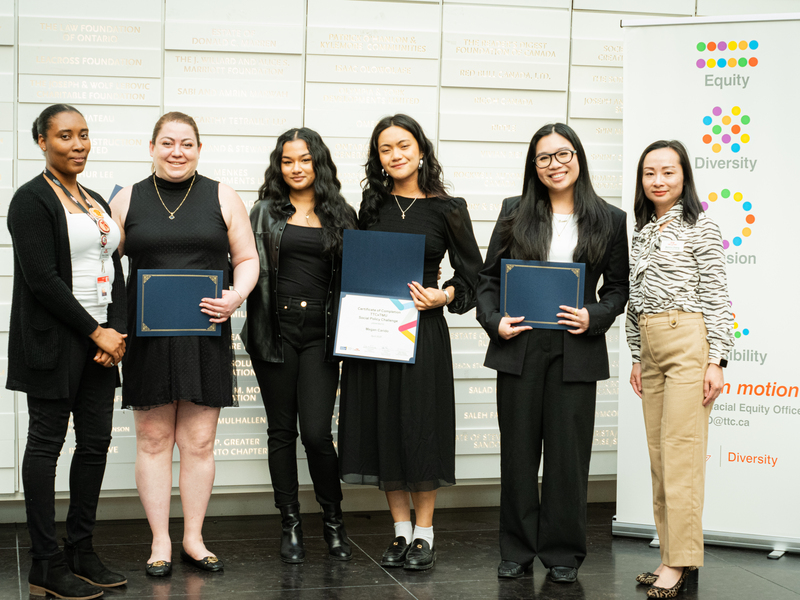
The TTC’s Allison Graham (far left) and Monica Zheng (far right) present certificates and $6000 grand prize to the winning team (centre left to right: Karoline Goodarzi, Nicole Sinanan, Megan Carido, Bianca Tapangco). Photos by Campbell Kaye.
For the second year in a row, at the TTC x TMU Social Policy Challenge, the Toronto Transit Commission (TTC) offered TMU undergrads the chance to pitch policy recommendations and innovative solutions to address issues of affordability, transit equity and homelessness.
First place and $6000 grand prize went to a proposal to convert underutilized TTC lots and decommissioned buses into compact, transitional sheltering for unhoused women experiencing violence.
Topics were real, not theoretical. Mentored by professors and commission representatives, teams troubleshoot actual issues facing TTC programs and services, including Wheel Trans, Warming Buses, underserved areas, and rising fare prices.
”The Challenge shaped how I think about accessibility and how to make a genuine difference in people’s lives. Transit doesn’t just move people — it can move whole communities forward.”
Early exposure, interdisciplinary collaboration
This year’s event introduced cross-disciplinary collaboration — an approach that even most working professionals still have yet to experience in practice.
Upper-year FCS students got the opportunity. Those from urban and regional planning brought systems-level, infrastructure and built-environment perspectives, while social work students used a lived experiences, “person-in-environment” lens to reduce human suffering.
Speaking of her winning team’s joint efforts, undergrad Bianca Tapangco said: “Our disciplines are different, but we share a focus on community well-being. Seeing their perspectives helped me think more critically and holistically about our proposal.
Faculty professor and land use-transportation planning expert Raktim Mitra knows the dilemma of providing effective public transportation for a large city like Toronto.
“It’s complex, with implications on equity and social justice. It’s critically important that, as aspiring professionals, our students learn to embrace the complexity of those challenges and solutions.”
The event demonstrated the value of — and growing need for — for industry-academic partnerships to equip students to successfully confront 21st century problems.
“Students offer innovative, research-informed ideas while industry provides mentorship, real world constraints and practical applications,” said social work professor and event jury panellist Denise McLane-Davison. “These partnerships create a dynamic ecosystem and synergy that’s mutually beneficial. It’s a win-win for all.”
“This year’s event created a space for dynamic perspectives — where urban planning and social work students offered a powerful, collaborative approach to problem solving. This is important to the TTC because it promotes innovative, interdisciplinary co-operation between key city-building institutions, leading to more inclusive, equitable and resilient communities”.
Special thanks
The Faculty of Community Services gratefully acknowledges the many individuals who generously supported the success of this year’s TTC x TMU Social Policy Challenge.
- Marlon Merraro, Director of Diversity and Culture Group
- Allison Graham, Instructor, Diversity Department
- Alexandria Hamilton, Diversity Consultant
- Monica Zheng, Manager, Racial Equity Office
- Kiaras Gharabaghi, Dean of Community Services
- Anamika Baijnath, Director of Experiential Learning, Quality Assurance and Strategic Initiatives
- Anthony Bakerdjian, Associate Director of Advancement
- Angeline Cheung, Awards, Recruitment and Events Coordinator
- Jasmine Eftekhari, Manager of Service Planning, Toronto Transit Committee
- Lorina Hoxha, Senior Project Manager, Transportation Services Division, City of Toronto
- Denise McLane-Davison, professor of social work, TMU
- August Pantitlán Puranauth, Organizer, TTC Riders
- Matthias Sweet, professor of urban & regional planning, TMU