Anne Harris explores traffic patterns, cycling safety and COVID-19
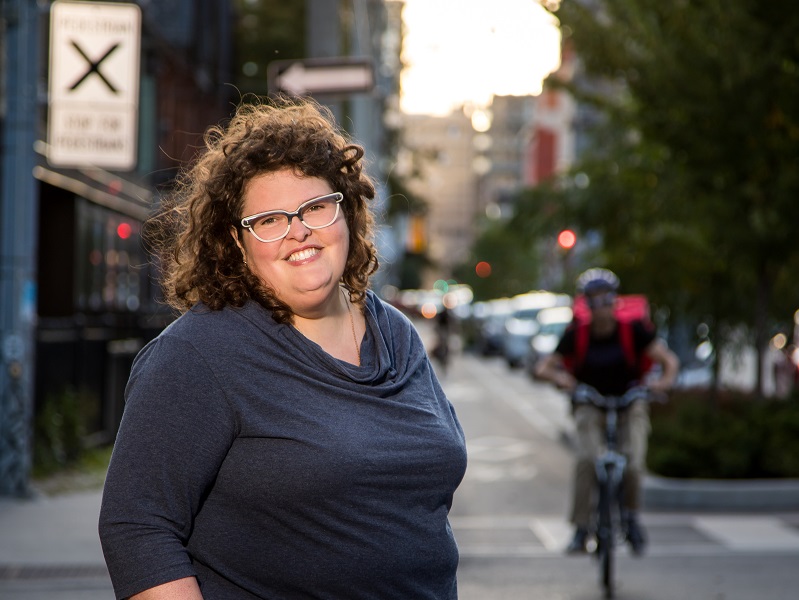
Anne Harris, a professor at the School of Occupational and Public Health, explores ways to make bicycle delivery and roads safer. Source: Anne Harris.
COVID-19 has made for a busy year for professors, like Anne Harris, at the School of Occupational and Public Health (SOPHe). She came to epidemiology through a love of patterns and an interest in exploring the unexplored. “I’m interested in any type of bias. For example, who is in and who is out? Who is or is not counted? Is there a distortion in the evaluation? I’m very curious about accurately describing what is happening around us, to know what to do or how to intervene.” Since 2020, Harris has been working on three new research projects -- two of which she has published and are COVID-19 related, and one that involves ongoing research on cyclist safety.
Traffic patterns during COVID-19
Harris published Changes in commute mode attributed to COVID-19 risk in Canadian national survey data (external link, opens in new window) in February of this year. She collaborated with Ryerson postdoctoral fellow Michael Branion-Calles (now at the University of British Columbia), exploring the changes in commuting patterns and transportation choices in cities across Canada during the pandemic. Findings demonstrated a reduction in all commute choices among those who could telework or study but not those who work in skilled trades or essential work. This study was partially supported by a Canadian Institutes of Health Research (CIHR) operating grant held by Harris.
COVID-19 experiences in bicycle delivery workers
In July of this year, Harris also published COVID-19 experiences in bicycle delivery workers (external link) in collaboration with Tracy Kirkham of the Occupational Cancer Research Centre. “This pilot study lays the groundwork for further study in this worker population,” said Harris. “We learned about how they coped with COVID-19, particularly in the first wave of the pandemic.” Harris noticed some distinctions in the types of Personal Protective Equipment (PPE) provided by employers. “We saw that it was pretty common for employers to provide face masks, but not other safety equipment like helmets or lights. Workers said customers were pretty good about maintaining distance. A bigger concern among workers was the precarious nature of the “gig” work that they do. There is certainly much discussion about the fairness of gig working and what constitutes an employment relationship. Being categorized as independent workers may allow employers to skirt around health and safety rules, and we certainly need to do more research on this population. There isn’t a central database of these workers, making them hard to reach. Those we did contact reported a high level of mask-use as a safety precaution. The workers we spoke to were uncertain about exposure, which we know is common because it can be difficult to trace. That’s a big challenge in occupational health research. Many workers wouldn’t know when they have been exposed to something that is not visible or otherwise detectable, without active testing and measurement,” said Harris. “I would like to look at this going forward. People who work in bicycle delivery face various exposure risks. These include vehicle and air pollution, noise, and sun exposure. They also face road hazards or risk slipping and falling while not riding. Nerve and repetitive strain injuries are a risk from repetitive action. And, broadly, the nature of bicycle work is changing. Stakeholders report differences between bike workers who have been long-time professional bike couriers with a distinct worker subculture and different pay structures that sometimes included benefits and those who are newer and more transient members of this workforce. So we also want to explore how the pandemic changes the availability of and people’s interest in various kinds of work.” This project was funded by a Centre for Labour and Management Relations (CLMR, Ted Rogers School of Management, Ryerson University) 2020 Faculty Research Grant and an internal proposal development grant from the Faculty of Community Services.
Multi-year research exploring cyclist safety
Harris also launched a large multi-year research project this year called Bicyclist and pedestrian crashes in Ontario: Detection and comparison of health outcomes between police-reported collisions and injury health care records (external link) . She and her team are studying linkages between health care records and road safety surveillance data. She is comparing hospital data with legally reported pedestrian and bicycle crash data to study gaps and overlaps. One longer-term goal of this research is to inform the building of safer roads. “There are several incidents that aren’t included in police data, for example, the types of crashes where they aren’t called, a swerve and miss, for example, or an accident involving two cyclists or a pedestrian. The highway traffic act governs when police are involved and the data that is reported,” said Harris. “The legislation mandates reporting for motor vehicle incidents, but there are many other ways to be injured as a cyclist. A previous study indicates about half of emergency room cyclist injuries don’t directly involve motor vehicle collisions. These accidents aren’t reportable under the highway traffic act. In road safety work, we rely heavily on police data, which are often more easily obtained and timely compared to health care records. Still, we also know that it’s also an incomplete data source, and so this study will take all of these reports and link them to health care data. That data will show us people who presented to the hospital for a pedestrian or cycling injury. Then, we can see if there are gaps, who is in the gaps, are there particular physical areas or road types with gaps, and we can look at socio-economic demographics. We can examine how severe the injuries are, knowing that more severe injuries are more likely to be picked up by police data. We can track what happens to people after their injuries in the health care system a year or two following their injury. We can then see how an incident was detected or reported and how did that impact care down the line.” Harris is collaborating with Michael Branion-Calles of the University of British Columbia and Laura Rosella of the University of Toronto, along with knowledge user collaborators at the Ministry of Transportation of Ontario. This study, financed by a $325,000 grant from the Canadian Institutes of Health Research (CIHR), began in 2021 and Harris is aiming for 2024 completion.
Cycling and thinking of ways of reducing accidents are what public health is all about for Harris, and the pandemic has underscored the value of prevention. “This is also where you can see a clear connection between occupational health and public health. I don’t think you can have either without the other,” she said. “It’s great that we have amazing doctors who can put people back together. That is truly amazing. However, if we can reduce the number of people who need to be put back together and save or deploy those medical resources in other areas where they are also needed, that would be better. The whole purpose of public health (including occupational health) is prevention -- an ounce of prevention is a pound of cure. Preventing a road crash, for example, is even better than having the most amazing treatments. The best outcome is not to have the crash. The goal of our study is to help reduce the number of accidents or crashes that may happen.”