The chef: How this professor creates life-saving technology in TMU labs
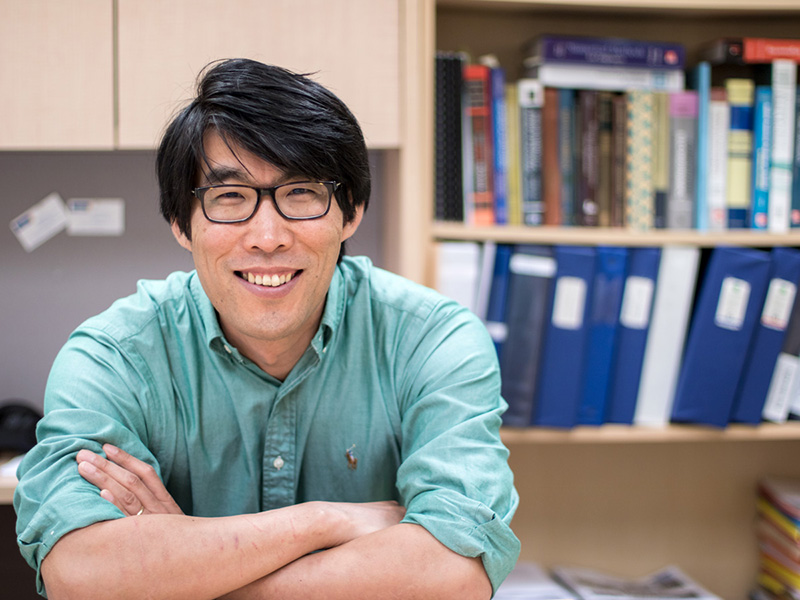
Dr. Dae Kun (Rilla) Hwang sees a lot of similarities between a chef crafting a perfect meal and creating polymers, substances that have molecular structure composed of similar components bonded together. Instead of his ingredients being food you would find in a fridge or pantry, his are chemicals, cooking them in tiny fluidic channels (channel size is close to hair thickness) under optical microscopes using UV light to create polymers that can be used for a variety of purposes.
“I consider myself the chef.”
Once the polymer has been created, just like a chef, Dr. Hwang can cook the ingredient in a variety of different ways. “We have exactly the same ingredient, but it depends on how you cook, how we control the water, our tools and the energy used, the time has to be precise” explained Hwang. “That's a difference as a chef, they know how to cook and they know how to do but actually they don't really know precisely. We control precisely and we know how it is actually combined into this, why the success of developing, why this shape is formed. We have to know the path and then you know the mechanism.”
The polymers can be applied to numerous different settings but Hwang’s focus remains on the biomedical side, where polymers can help detect proteins closely related to diseases such as cancer. Other uses that have been looked at by Hwang include energy storage, using polymers in combination with metallic materials in batteries.
“We use exactly the same tools, but depending on how we cook it, how we manipulate it, how we actually do it, we can use the same materials composed of the same precursors, however their functionality and properties are different.”
Dr. Hwang is the Canada Research Chair (CRC) in Microarchitecture for Advanced Polymeric Materials and Principal Investigator of TMU’s Advanced Material Research Group. He’s taught at TMU since 2011 after completing his bachelor's degree at Chosun University in South Korea in 1998, and his masters and doctorate degrees at McGill University in 2002 and 2006 respectively. He also spent time at the Massachusetts Institute of Technology (MIT) and the University of Saskatchewan.
The adaptability of softer materials in chemical engineering was a draw to Dr. Hwang. “I like soft material. So chemical engineering, we're dealing with soft material. It's not hard materials, like in mechanical engineering. In chemical engineering, most likely we are dealing with liquid, gas, and polymers.”
Dr. Hwang prefers the freedom of independence in academia as a self-driven person, but always gets energised teaching his students in his classes as well as the fellows in his Advanced Material Research Group.
“I can give something to the students and they can be a creator. Engineering is not only made in the lab or some factory, but also we're developing and creating something outside of that.”