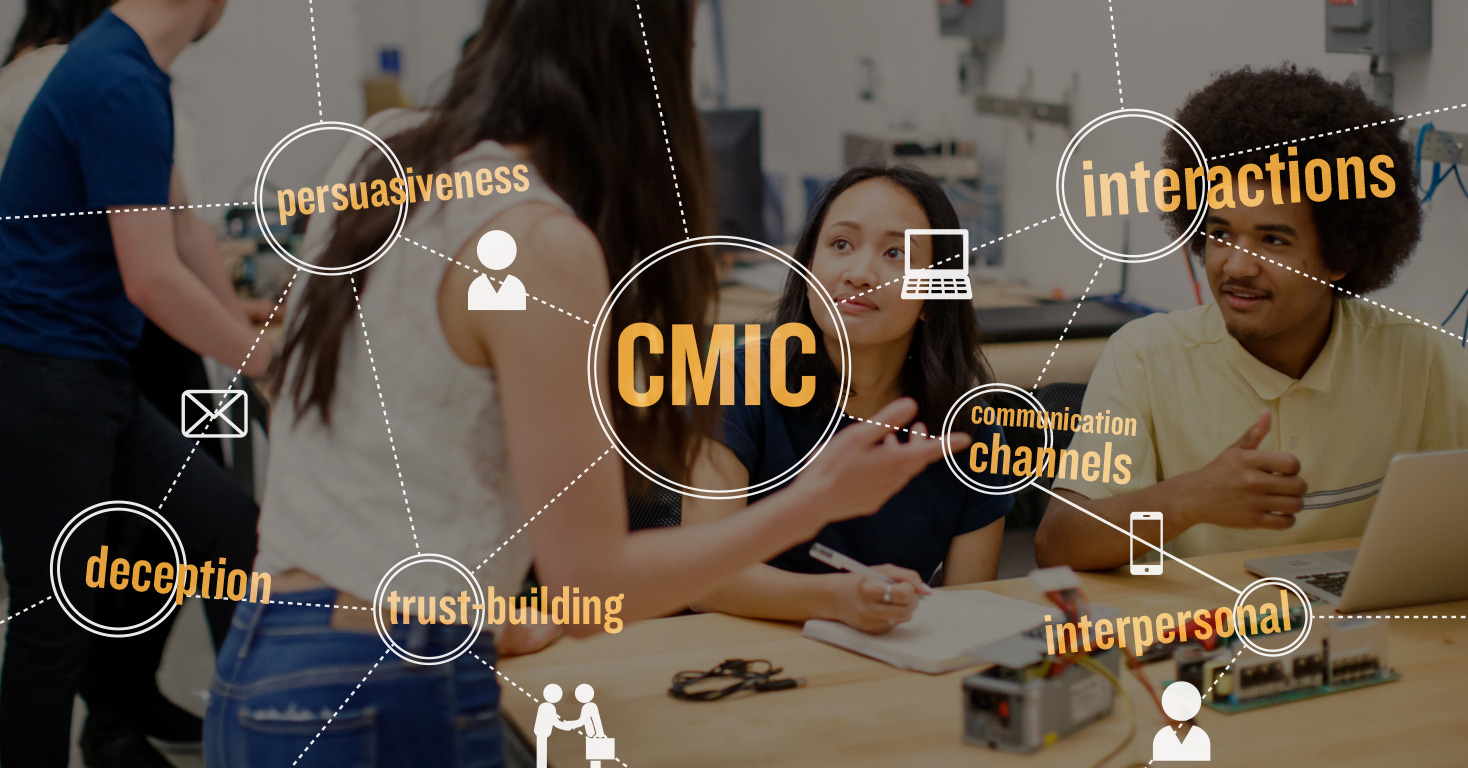

The Computer-Mediated Interpersonal Communication Lab (CMIC) is an academic research lab at Ted Rogers School of Management at Toronto Metropolitan University (TMU). At CMIC Lab, our focus lies in delving into the intricate social dynamics of computer-mediated communication (CMC) and exploring the extent to which these digital interactions yield unforeseen interpersonal outcomes. This lab is led by Dr. Mahdi Roghanizad, an Assistant Professor at TMU.
Communication and Information Systems researchers have extensively discussed the limitations of CMC in conveying emotion and information. However, the purpose of communication extends beyond mere information exchange. We are interested in studying the impact of various communication channels on social outcomes, such as persuasiveness, trust-building and social predictions (e.g., deception detection, predicting cooperativeness, predicting trustworthiness, etc.). Furthermore, we investigate the perception accuracy of communicants regarding the advantages and disadvantages of the channels they use for interaction.
What we’re working on
Interpersonal Trust in Mediated Communication
Lead researchers: Imaan Syed, Sheran Taneja & Erika Drakes
Recall and Visual Color Perception
Lead Researchers: Girvani Adhikari, Timothy Njenga, Erica Du & Anika Kaniewski
Transcription Project
Lead Researcher: Emmanuelle Allen, Kat Lozano & Pranaya Arunthavarajah
 Pending publications
The Role of Glucose Level in Blood in Cybersecurity Behaviour
Lead researcher: Tiffany Paquin
Deception Detection in Computer-Mediated Communication
Lead researcher: Alexis Illes
Emotion Expression and Public/Private Self-Awareness in Video-to-Video vs. Face-to-Face Communication
Lead researcher: Emma Hoskin
Our publications
Latest refereed journal article
- Roghanizad, M. M., & White, R. E. (2025). Predicting strangers’ cooperativeness in Face-to-Face vs. Video-to-Video interactions: A case of inaccurate social prediction in mediated communication. International Journal of Information Management, 84, 102913.
- Neufeld, D. J., Roghanizad, M. M., & White, R. E. (2025). The Impact of Video-Mediated Communication on Social Predictions and Theory of Mind Activation. International Journal of Human–Computer Interaction, 1-14.
- Roghanizad, M. M., & Turetken, O. (2024). Resource-seeking and media choice process: A case of irrational decision making. International Journal of Information Management, 74, 102714.
- Roghanizad, M. M., & Bohns, V. K. (2022). Should I Ask Over Zoom, Phone, Email, or In-Person? Communication Channel and Predicted vs. Actual Compliance. Social Psychological and Personality Science, 13(7), 1163-1172. Featured in Harvard Business Review article ‘Need a Favor? Research Suggests It’s Best to Ask In Person.’
- Roghanizad, M. M. & Neufeld, D. (2015). Intuition, Risk, and the Formation of Online Trust. Computers in Human Behavior, 50, 489–498. Featured in Harvard Business Review article ‘Research: How Customers Decide Whether to Buy from Your Website.’
- Bohns, V. K., Roghanizad, M. M., & Xu, A. Z. (2014). Underestimating Our Influence over Others’ Unethical Behavior and Decisions. Personality and Social Psychology Bulletin, 40 (3), 348-362. Featured in New York Times article ‘Would you lie for me? Why we underestimate our powers of persuasion.’
Latest conference presentation
Illes, A. J. and Roghanizad, M. M. (2024). Deception Detection in Computer-Mediated Communication. Administrative Sciences Association of Canada 2024 conference, Montreal.