SDG 15: Life on Land
SDG 15: Life on Land
Through our academics, research and operations, TMU is helping protect life on land. As an urban campus with a limited footprint, we focus on advancing knowledge, supporting biodiversity and partnering with our community to promote sustainable land use locally and globally.
Our goals in action
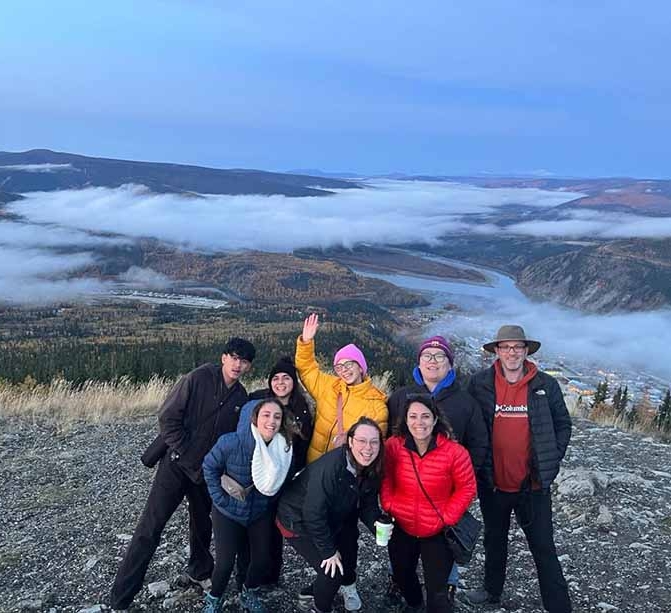
(Photo credit: Sonya Graci)
Through experiential learning, TMU students explore how tourism can promote sustainable land use and support local communities. Courses and field studies connect classroom learning to real-world challenges of conservation, reconciliation and sustainability.
- In fall 2023, students from TMU’s Hospitality and Tourism Management program travelled to the Yukon and Northwest Territories to gain an experiential understanding of how tourism can contribute to sustainable livelihoods. The journey encouraged students to connect their studies and skills to people, events and issues in local communities and to understand challenges as a way to develop their own careers.
- The 10 students from HTT800 Field Studies in Hospitality and Tourism joined Sonya Graci, professor and director of the Institute for Hospitality and Tourism Research, on a journey to northwestern Canada to learn from local leaders about Indigenous issues, policies and ways of life in Canada’s north. The trip provided students with an authentic Arctic experience and insight into the daily life of Indigenous peoples as they examined issues related to reconciliation, climate change, food security and sustainable livelihoods.
TMU researchers are advancing solutions to protect habitats and reduce human impact on ecosystems. From sustainable food innovations to wildlife conservation and smarter infrastructure, our researchers tackle complex challenges affecting life on land.
- Aerospace Engineering professor Goetz Bramesfeld works with Environment and Climate Change Canada (ECCC) to survey woodland caribou habitats using a solar-powered aircraft. This gives ECCC unprecedented access to collect data and make informed decisions for natural resource extraction and land management.
- To restore ecosystems and reconnect fragmented habitats, Nina-Marie Lister, a professor at TMU’s School of Urban and Regional Planning, studies and advises on the planning and design of wildlife crossings – from overpasses to tunnels – that support breeding, feeding, gene flow, migration and reduce vehicle collisions across regions from Alberta to Los Angeles.
Professor Lister’s team and partner ARC Solutions pioneered a network of crossings in Canada’s Rocky Mountains. Overpasses in Banff (1996) and Yoho National Parks (2018) spanning the Trans-Canada Highway have become global models. The opening of the Bow Valley Crossing near Canmore, Alberta, in 2023, was the first of its kind spanning the Trans-Canada Highway outside a Canadian national park. Built on the traditional territory of the Stoney Nakoda people and followed by another under construction on Highway 3 in British Columbia, these crossings offer an integrated set of solutions for future development.
Across campus, TMU integrates sustainability into daily operations and campus culture. Initiatives to reduce waste, limit pollution and promote responsible resource use help protect land and ecosystems for future generations.
- The Pitman Dining Hall is a 3 Star Certified Green Restaurant under the Green Restaurant Association's rigorous standards in categories like water efficiency, waste reduction, sustainable food, and chemical and pollution reduction.
- Between 2018 and 2021, TMU took action to improve its waste diversion rate by transitioning the campus from a three-stream system (waste to landfill, bottles and cans, and paper) to include a fourth stream - organics. This included upgrading infrastructure to ensure consistency of waste bin type and signage across campus, and actively engaging and training students, faculty and staff on how they can take part in reducing waste and maximizing recycling.
The Sustainability Office hosts engagement events, including interactive sorting games, to help students, faculty and staff learn what waste goes where and support a campus reuse culture. - As part of TMU’s waste reduction strategy, initiatives like the Branded Materials Transition Project, Free Store and Furniture Rehome Program help divert materials from waste streams, disrupt throwaway culture and reintroduce unwanted items into service through reuse or repurposing.
- TMU Eats encourages the reduction of single-use items through its reusable OZZI container program, offering a bring your own mug discount, and eliminating single-use plastics such as straws from its retail locations.
- TMU participates in the Plastic-Free July (external link) movement, encouraging students, faculty and staff to participate in weekly challenges and get practical tips for making more sustainable choices, adjusting long-standing patterns and adopting new practices.
Through procurement, research and advocacy, TMU helps protect biodiversity and promote sustainable land use locally and beyond. Collaborations with community groups and policy efforts bring knowledge into action for real-world impact.
- TMU Eats provides professional training for their chefs under the Forward Food Program developed by the Friends of Humane Society International. The hands-on training program teaches food service professionals how to incorporate plant-based foods into their menus and place sustainability at the centre of their menu decisions.
- Parks in Action: Towers, Hubs and Opens Space Transformations (external link) highlights the role of parks, open spaces, and the public realm in fostering climate action in Toronto’s inner suburbs. This is a joint initiative between TMU’s School of Cities and the University of Toronto.
- Professor Nina-Marie Lister of TMU’s School of Urban and Regional Planning leads the Ecological Design Lab (external link) , which looks at ecological health from a planning and design perspective. With her students, she successfully advocated for the City of Toronto to amend its Long Grass and Weeds Bylaw, protecting the right to cultivate natural gardens that actualize the biodiversity goals identified by the City of Toronto. Armed with her knowledge of ecology and mission to improve urban biodiversity, she fought the previous bylaw, lobbying for a more ecologically resilient amendment to allow natural gardens as-of-right.