Book on Indigenous identity, hockey wins Governor General's Award
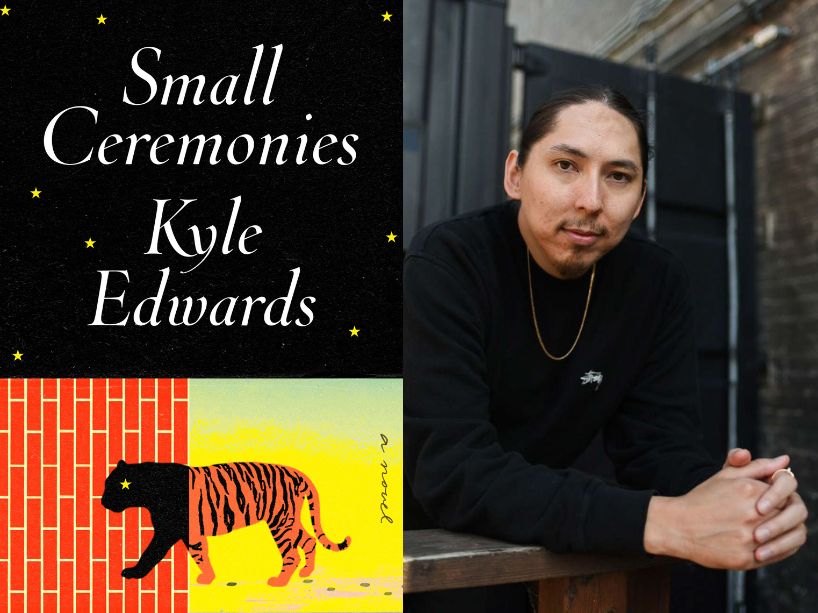
TMU grad Kyle Edwards (Journalism '17) has won one of Canada's most important book awards for his first novel exploring the crosscurrents of Indigenous identity and hockey culture.
Small Ceremonies (external link) tells the story of two Indigenous high school boys in Winnipeg's North End. Tommy and Clinton are best friends and hockey teammates facing tough challenges on and off the ice.
The novel won the 2025 Governor General's Literary Award for fiction in early November and is shortlisted for the 2026 Dublin Literary Award.
Chasing hope
Central to the novel is the community’s hockey team, the Tigers. On the ice, the players face racial tension and unfair treatment – problems that mirror their everyday lives.
“Hockey is one of the greatest sources of nationalism in Canada and national pride in general.”
After fighting through a losing season, the team receives the news that they are being forced out of the league.
Edwards shares different accounts of community members to explore themes of identity, trauma, hope and the rituals that help individuals survive in a place that fails to make space for them.
Growing up Indigenous in Canada
Edwards grew up on the Lake Manitoba First Nation and is a member of the Ebb and Flow First Nation.
Before writing his novel, he worked as a journalist for Native News Online, ProPublica and Maclean’s. He also held fellowships at Harvard and Stanford Universities. He is currently a provost fellow at the University of Southern California and editorial staff at The New Yorker magazine.
In Small Ceremonies, Edwards switches between different characters’ perspectives. Readers see the world through their eyes to understand the issues affecting Indigenous communities.
Identities at odds
The characters struggle with what it means to be Indigenous and Canadian. Historically, Canada has often tried to erase Indigenous identity. Today, systemic problems continue to make existing inequalities worse.
"Indigenous people belong to distinct nations that grapple with what it means to be a Canadian citizen."
“It’s a common experience for Indigenous people,” says Edwards. “When you come of age in Canada, you start to become aware of the world around you, its historical legacy and your place in it.”
Canada’s history and its treatment of Indigenous people over generations forces young Indigenous people to question their own connection to Canadian identity, says Edwards.
Hockey culture and Canadian identity

Across Canada, from small towns to major cities, hockey players give everything to a sport that hasn’t always been fair or inclusive. Photo by Tony Schnagl via Pexels (external link)
Hockey culture has long influenced Canadian identity, often drawing lines between who’s included and who isn’t. The culture can be toxic and unwelcoming.
“We love this game, but oftentimes, this game doesn't love you back.”
Yet, hockey matters deeply to the young men in Small Ceremonies.
“Hockey is a unifier in Canada,” says Edwards. “It gives Canadians a strong sense of identity and nationhood.”
In the novel, hockey saves the young men who play it. It gives them a purpose and brings the community together. “For better or for worse, it looms large in their life.”
As readers follow Tommy and Clinton’s story, they witness discrimination and violence on the ice. The boys describe the game as cruel, even ruthless. But the fighting gives them a chance to prove everyone wrong.
Edwards wanted to write about a sport that matters to many Indigenous people.
“It's important to all Canadians, but hockey in Indigenous communities is a big deal,” he says. “We're so passionate about it.”
He believes the notion that sports are separate from politics is misguided and even irresponsible.
“Sports are inherently political and they carry emotional and historical weight,” he says. “That’s why I felt that hockey could contain all the different themes in this story.”
The tenacious student reporter
The book also features Clarissa Walkman, a bold student reporter investigating why the league is trying to shut out the only Indigenous team.
Edwards wanted to create a young, idealistic person, who believes journalism can create change.
“I wanted someone who understands that Indigenous communities and other marginalized groups in Canada haven’t always been given a fair shake in the press,” says Edwards. “We have this misconstrued idea about what objectivity means in the news media.”
Edwards too was a student campus media reporter during his time at TMU.
“Those were really important years in my life,” he says. “I loved reporting for the campus newspaper, filming interviews, and then editing everything together. Those moments were thrilling, and some of my favourite memories from university.”
He vividly remembers one of his first days in class. A professor sent the class outside to talk to 10 strangers on the street and ask them questions about their lives.
“It was an exercise meant to make us more comfortable speaking with people, and I remember being absolutely terrified,” recalls Edwards. “But it taught me so much about listening, learning and having empathy for others.”
He says he looks back fondly on that experience and his early days as a young student journalist.
From hockey dreams to writing success
Edwards knew he wanted to be a writer, but it ranked second to becoming a professional hockey player. He grew up playing the sport.
“It was my backup plan if the NHL didn't work out,” he shares with some humour.
Edwards' grandmother was the librarian at his school, growing up. She cultivated a love of reading in him.
Writing this book was a dream he carried his whole life. When he finally put pen to paper, it was his grandmother who eagerly asked him over the years when it would be finished.
Not only has Edwards’ debut novel lit the lamp, it’s a victorious reckoning that invites us to bear witness and take part in the national story.