What shifts are needed for real impact on climate change?
The climate crisis is worsening worldwide, and communities who have produced the least amount of greenhouse gas emissions will bear the brunt of it. What shifts can Canada make in the way it approaches climate plans?
The latest UN report on climate change (external link) has just come out, and it’s damning. Canada’s latest targets for greenhouse gas emission reductions by 2030 remain woefully inadequate (external link) . And just this past summer, the country has seen dramatic climate responses including a record heat wave in B.C. that set the province ablaze with wildfires.
Canada’s latest climate plan, A Healthy Environment and a Healthy Economy (external link) , states itself that greenhouse gas emissions generated by Indigenous communities are “modest”: “estimated at less than one million tonnes per year across the country.” For comparison, Canada's total emissions in 2019 were 730 megatonnes (external link) .
Yet Indigenous communities have disproportionately felt the impacts of climate change to date, and will continue to as the crisis worsens.
“It was only a few years ago that we celebrated Canada's 150th anniversary, so as a country, we're very young and the science of climate change is relatively young as well,” says Amber Sandy, Indigenous knowledge and science outreach coordinator with SciXchange. “Thinking about that in relation to Indigenous Peoples and our time spent with this land, our knowledge systems are so deeply based on the environment around us, and since time immemorial, we’ve been living in relation with these plants and animals. The knowledge is so vast.”
Sandy says many of the markers of climate change that we are now studying have been things that Indigenous communities have seen first hand for many years. “Our communities are still living on the land and still out there hunting, fishing and foraging. We've had so many years of studying, observing and documenting weather patterns and animal movements and behaviours, as well as plant growth. We’re an untapped base of knowledge that has never been respected enough to be utilized in a way that would be helpful for this work.”
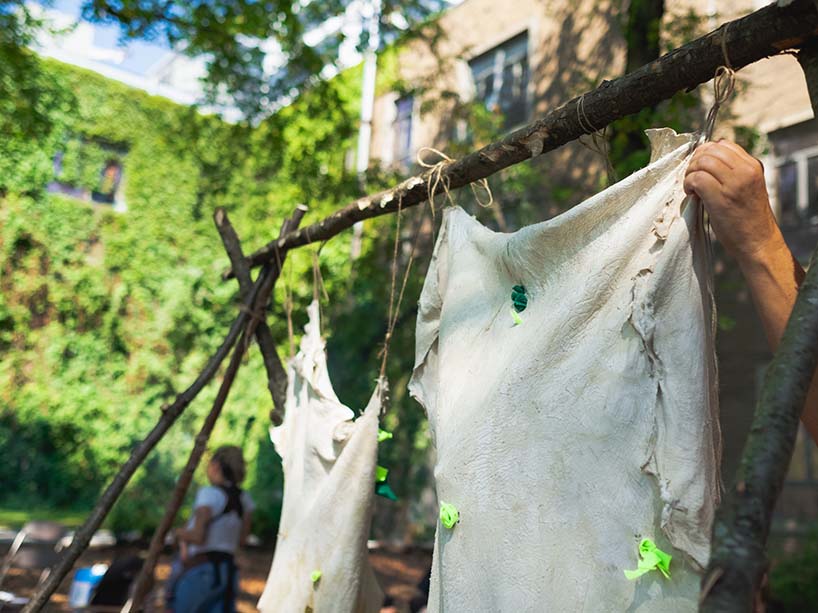
Over the last few years, Sandy has been striving to learn more traditional practices in her own community, and in this short time span, she’s already noticed huge changes. “Maple syrup harvesting started really early for everyone this year because spring came a lot sooner than we were anticipating. And speaking with other hide tanners, knowledge holders and elders, I’ve heard about the differences in moose hides over the years: we're seeing so many more ticks on the hides that we wouldn’t normally see so far north. Examples like this show us the difference in their livelihoods too, because they're also being impacted by climate change. It’s the same with fish.”
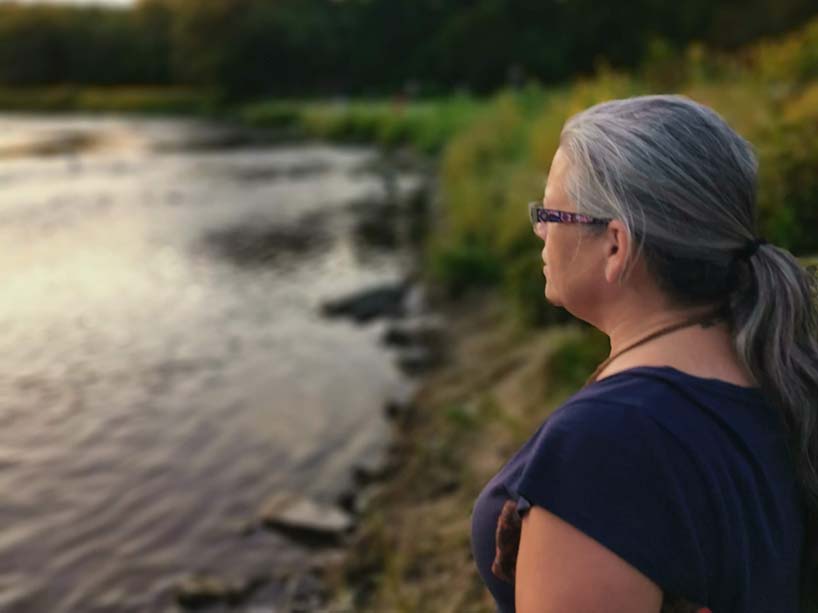
Melissa Roberts standing at the edge of the Humber River in Toronto, Ont., during a hide camp.
A duty to consult?
Indigenous Climate Action, an Indigenous-led organization comprised of Indigenous knowledge keepers, water protectors and land defenders from communities and regions across the country, conducted a research project on federal climate policy and determined that the federal government diminished Indigenous Peoples’ constitutional rights by consulting Indigenous Peoples merely as stakeholders rather than central rights holders, and not giving them seats in the actual working groups.
“The stakeholder language can have the effect of equalizing all of the different parties that the Government is consulting,” says Scott Franks, a professor at the Lincoln Alexander School of Law. “It treats every party the same, whether they’re a representative from a national business organization, the oil and gas sector, or an Indigenous nation. And the problem with that is that Indigenous nations have constitutional rights and exist as sovereign nations. So their citizens’ concerns are obviously different from the concerns of a corporation.”
Franks says that it’s only relatively recently that the federal and provincial governments have started to recognize the value of traditional ecological knowledges (TEK) in statutes that govern decisions over the environment. “Part of the reason for that recognition is societal in terms of the values that Canadians are bringing now to their governments, but the other parts include what has been set out as Indigenous Peoples' constitutional rights in the Constitution Act of 1982.”
The crown has the duty to consult Indigenous communities when an Indigenous right might be at stake, say for example in a resource extraction project. But with vague language surrounding these rights, that duty to consult can be elastic.
“The constitutional duty to consult is limited in scope; it only applies when there are Aboriginal rights or titles at stake,” says Franks. “So the crown sometimes takes the position that neither of those things are at stake. If a decision impacts an Indigenous community in a way that the federal government and the court hasn't recognized as a constitutional right, then that obligation to consult will not come up.” This means that Indigenous communities can be left out at the consultation phase on environmental impacts to all aspects of Indigenous Peoples' way of life, such as the ability to teach children and pass on knowledge about the land.
Meaningful steps forward
Addressing the climate crisis in a meaningful way needs to start with the root causes -- capitalism, invasive natural resource extraction and colonialism -- or Canada’s climate plans will continue to fall short and time to act will run out. Part of this process needs to involve recognizing Indigenous Peoples’ sovereign rights and valuing TEK in the consultation and decision-making processes.
Franks says training in the value of TEK for settlers sitting at decision-making tables is one step toward making this shift. At these decision-making tables, “a lot of information is brought by experts who are trained in more mainstream or European scientific methods, and many of the decision-makers have very likely gone through an education system that prioritizes that kind of knowledge,” says Franks. “And so, if they're not familiar with TEK, they may not understand the full significance of this information that they're being provided, and they may prioritize the information with which they’re more comfortable working.”
The effect of this is that Indigenous communities’ concerns are not actually being considered in any meaningful way. Franks says there's a variety of different possibilities for what that training might look like. “I think that to understand TEK, it requires a more robust education in Indigenous People's ways of life, how they understand their relationship to the environment and how they observe and communicate changes to the environment.”
“There needs to be more training about Indigenous ecological model systems. Then, board members may be better prepared for meaningfully considering that knowledge when it's brought before them.”
Better than training, says Franks, is reforming who gets to make decisions. “The federal government could recognize the authority of Indigenous nations to make decisions with respect to their own territory to use their own decision-making tools, their elders, community circles, whatever deliberative mechanism they have in the community. That is part of recognizing Indigenous Peoples' sovereignty and self determination as a nation, and also their relationship to their territories.”
“I truly feel that western science will deeply benefit from working with Indigenous communities in a respectful way and without trying to fit Indigenous knowledge and science into the box that is western science,” says Sandy. “It’s knowledge that has kept people and communities alive for many generations.”