Ryerson orientation leaders get ready to welcome students
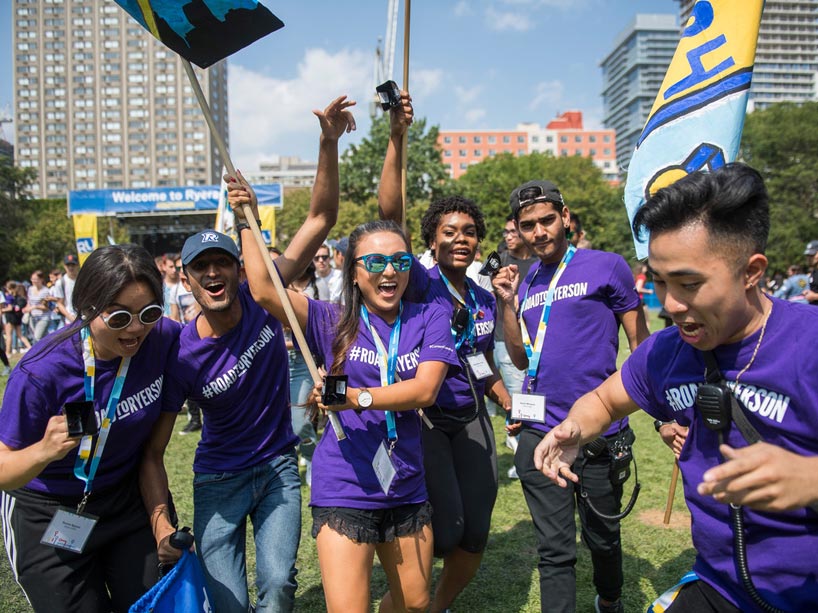
Ryerson Orientation Crew members are a big part of the festivities in welcoming and cheering on incoming students.
Orientation Week gets underway Monday, August 26 and close to 400 student-volunteers will be welcoming approximately 10,000 new students to campus.
Organizing a week of activities, games, info sessions, concerts and meals is no easy feat but the Ryerson Orientation Crew is dedicated to making the transition to post-secondary school effortless and smooth for incoming students.
Ryerson Today provided a short but go-to guide for all things orientation-related, including diverse events such as the YOUnique: Body Positivity Fashion Show, Hoops on Wheels: Wheelchair Basketball and LGBTQ2S+ Mixer. Events like these reflect the all-embracing nature of this year’s orientation.
To help student-volunteers perform at their best during Orientation Week, RU Student Life organized a weekend-long training session for all volunteers. RU Student Life collaborated with student societies across the faculties to offer a broad range of training facilitated by upper-year students, faculty, staff and graduates.
To reflect Ryerson’s diverse population, sessions covered a range of equity topics including bias and privilege, introduction to equity, diversity and inclusion, consent education and awareness and supporting specific demographics of students, including: students with disabilities, 2SLGBTQ+ students, international students, and those who commute. This is the first year that volunteer training has been expanded to such an extent.
“Volunteers are often the first touchpoint for new students who have no idea of the supports and services available on campus,” says Jen McMillen, vice-provost, students. “It’s important that volunteers are well-informed and approachable to help students feel welcome, secure and comfortable during their transition to post-secondary.”
Student Life has developed a curriculum to help student-staff act as supports for peers. The training sessions are tied to this curriculum, which focuses on taking academic theory outside of the classroom and incorporating it into student life.
Amanda Lin, School of Disability Studies 2019 graduate, co-facilitated a session on supporting students with disabilities. Lin worked in Student Affairs for four years in Tri-Mentoring and identifies as someone with an invisible disability. The one-hour session included discussion on language, physical space and expectations, accommodation and accessibility.
“Welcoming students with proper language sets the tone for a positive experience,” Lin said. “We need to make room for all different kinds of folks who will be on our campus. So this session was a polite forum to help volunteers boost their confidence and create a safe space to ask questions. Simple things like saying ‘it’s over there’ can be hindering rather than helpful. Going with someone, actually showing them where something is – sounds like simple customer service but it goes a long way for someone with a disability.”
On the surface, orientation may appear to be all fun and games but at its core, it aims to build community amongst students. Facilitators, volunteers and staff are invested in helping students make connections with new peers, develop social perspectives and build relationships.
This is the third year retail management student Sonya Sevadjian has volunteered to be on the Ryerson Orientation Crew.
“I want students to feel as comfortable as I do going to Ryerson. It’s scary at first but you find your footing and I want to be there for those first-years,” she said. “The training helped me develop my own knowledge and opened up my eyes to my own biases. To be inclusive is to be aware of that and actively unlearn those biases.”
Asad Malek from business management remembers the enthusiasm and energy of Ryerson Orientation Crew members from his first orientation. He attended a session that focused on commuter students.
“It created a cool atmosphere and it’s a unique experience both volunteering and being a first-year. We were all first-years at one time so this is our way of giving back,” Malek said. “With the expanded training, we took an in-depth look at some of the issues students face and ways to approach and mitigate them.
“So an example is commuting. We talked about how it can be a difficult part of a student’s journey, literally and metaphorically! Since that can affect a student’s experience, in terms of grades, social life, extracurricular activities, we talked about how we can promote healthy commuting. Since we're practically the first touchpoint students get when coming into university, it's almost our job to give students an understanding of the culture and expectations of university.”
To know more about orientation, please visit https://www.torontomu.ca/studentlife/programs/orientation/.