The healing power of storytelling
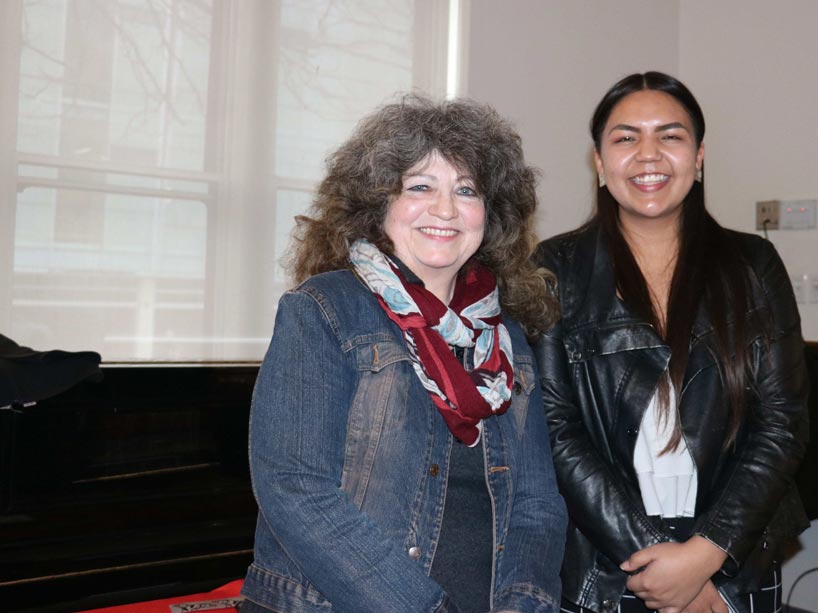
As part of the Aboriginal Student Showcase, Deborah Smith (above, left, with image arts student Victoria Anderson-Gardner) screened a pilot episode for her “Indigenous ‘Oprah’-inspired Talk Show.”
“In the Indigenous community, storytelling is medicine.” This is how graduate student Deborah Smith, who is Cree Métis from Alberta, describes one reason she pursued a master of arts in media production at Ryerson. “We teach with stories and can use them to heal and make sense of our journey.”
Smith’s graduate work was recently showcased in the annual Aboriginal Student Showcase. She screened an 11-minute pilot episode with the working title, “The Indigenous ‘Oprah’-inspired Talk Show.’ The pilot is one of five projects that make up a prospectus that will be part of Smith’s major research project. The show was hosted by Samantha Mandamin, academic support advisor with Ryerson Aboriginal Student Services. Smith hopes to develop the program into a regular series and plans to pitch it to broadcasters, investors and sponsors.
She also has plans to develop a production hub called the Reconciliation Narrative Agency (RNA), modelled on the Detroit Narrative Agency (DNA).
“The DNA is a community of filmmakers who are given small grants to change the local narrative to one with a vision for a future,” she explained. “The idea for the RNA is to change the dominant narrative by finding ways to incorporate storytelling that hasn’t been from us, to mobilize Indigenous knowledge and to develop and produce Indigenous creative content for mainstream audiences.”
The RNA initiative would have three arms – a production house, a research and development component to develop a sustainable creative economic model that can be used in Indigenous communities, and a professional development resource for Indigenous talent in all areas needed for the media and entertainment industries.
“Through the RNA, the Indigenous community can tell their stories and create content that bridges our audience with the mainstream audience,” she explained. “Wider audience at first and then working our way into the mainstream.”
With years of experience in media production, screenwriting, and creative development in Hollywood and Canada, Smith hopes to continue creating and producing content and building opportunities for Indigenous communities and youth to grow as content creators for mainstream audiences worldwide.
She sees her work as being part of a larger cultural journey connected to past generations, paving the way for future ones.
“My cultural teachings are that we are responsible for the next seven generations, that we stand on the shoulders of our ancestors, and need to respect the work they’ve done,” she said. “My role is to be mindful, resilient, and to honour our ancestors and the Great Spirit.”
Several years ago, a search of family history revealed that Smith and her family were part of the Papaschase First Nation (external link) in Alberta.
“When I finally found out, it really grounded me in my legacy, it was an amazing moment,” said Smith. “It made me think out my writing in terms of Indigenous characters and themes and stories. All the time I’d spent in L.A. finally meant something. It gave my projects new meaning and sense of purpose.”
The purpose being to use the conventions and story structures of Hollywood films to convey Indigenous themes and characters. Smith calls this concept Radical Indigenous Third Entertainment Space (RITES).
As part of this concept, she’s working on a feature film that she describes as “Bad News Bears meets Slapshot,” with an Indigenous lead character who discovers he was part of the Sixties Scoop and returns to his community.
Smith credits Aboriginal Student Services for providing much needed support when she arrived in a new city to begin her graduate program last fall.
“Ryerson Aboriginal Student Services have been amazing, with their support and as a hub where we can all gather,” she said. “They have been fantastic and truly helpful with financial support and scholarships, as well.”
To learn more about the programs and support that are available, visit Aboriginal Student Services.