


The Tickling House
The
Tickling House is a theoretical project that explores the poetics of making.
It exemplifies characteristics of a body and church, and explores aspects
of the senses. Ideas were inspired by two sources: a narrative and found
objects. The narrative, storytelling, became a significant way of gathering
ideas about the essential nature of man. Recorded as satirical verses
on the interior walls of an 18th century English garden structure, it
became the impetus for a project of reconciliation between bodily desire
and religion, with aspects of the garden and humour acting as main connecting
tools.
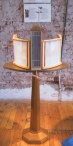
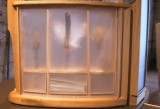
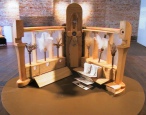
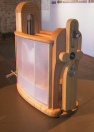
The found objects, consisting of discarded chair parts crafted of wood, initiated the actual process of making by providing ideas about scale, form and structure. They also represent an approach to recycling as a way of exploring new ideas about making. Instead of eradicating the original, the goal in this instance was to maintain the essence of the original form as a way of generating ideas about rebuilding.
Akin to these ideas,
the project evolved as a meditation upon the process of craft as a symbolic
forum for architecture, revolving around such principles as the role of
the body, particularly the use of the hands, and the value of collaborative
making. Perhaps a reconsideration of the significance of these traditions
could restore to architecture opportunities for an increased awareness
of the limitations imposed by a profession driven by technological trends
that encourage isolated specialists.
 |
 |
 |
 |