Interactive Activity
Community maps can be used to show the different services that a family interacts with, highlighting the work that is done by families to navigate multiple services. This community map is not based on a specific family but an aggregated version of what some families experience in several communities (see Underwood, forthcoming for further detail). There are many ways to map family experiences. Some of these include geo-spatial mapping (looking at the geography of services), journey mapping (focusing on the families’ pathway), and eco-mapping (looking at the micro, meso, and macro relationships between the child/student, family and professionals) (Martin, et. al, 2017). The following map was developed using institutional ethnography, a method that seeks to illuminate institutional processes and power through the everyday activities of actors in the system. In this case, the map is drawn from the viewpoint of the family. This approach allows us to see the number of institutions that the family is interacting with, which may be unknown to individual professionals working within single programs or services. The viewpoint of the family, may differ from how the agencies and funders see the services.
Community Map
Below a case study animates the experience of the family represented by this map.
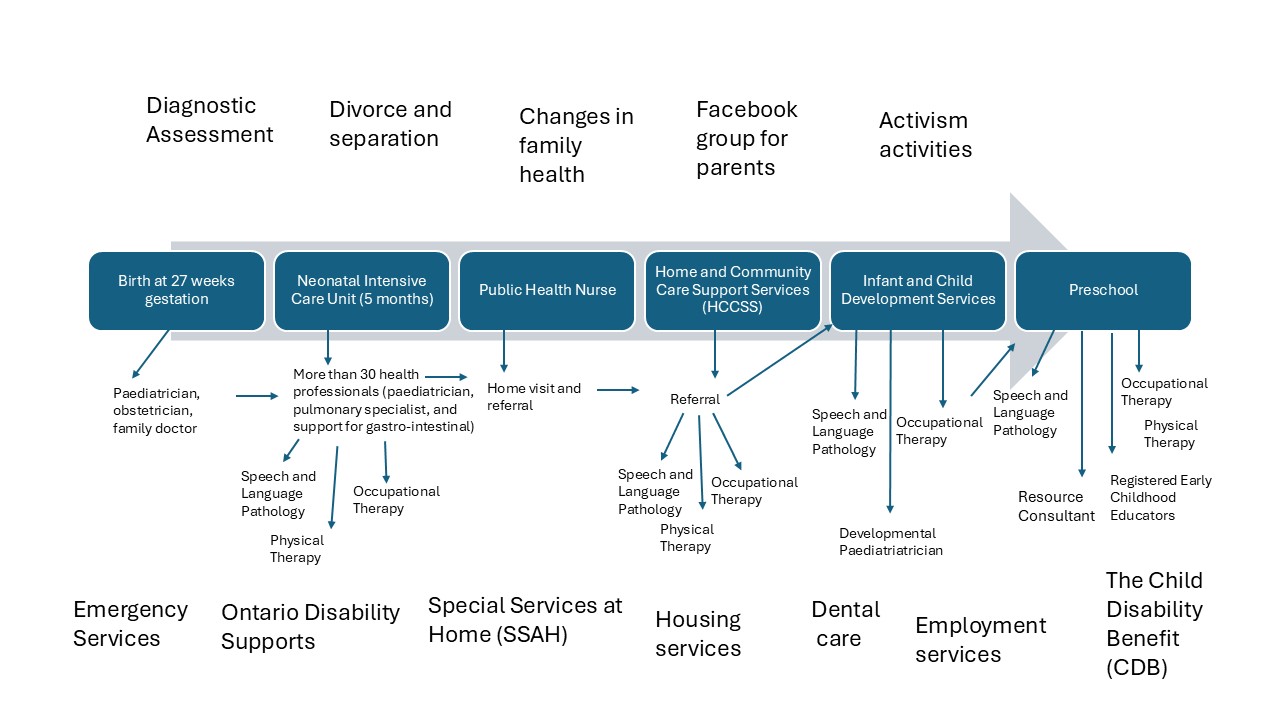
Community
Map of Family interactions with services (© Underwood 2026)
Case Study
The case study animates the experience of the family represented by this map.
Laura was born at 27 weeks gestation. As is usual in this situation, she spent many months in the neo-natal intensive care unit as her lungs developed and medical professionals monitored her development and health concerns. Both of Laura’s mothers interacted with more than 30 health professionals in the hospital before Laura was released to go home. Following their time in the hospital, Laura continued to have regular appointments with a paediatrician, pulmonary specialist, and support for gastro- intestinal development. Three days after being released from the hospital, the family had a home visit from a Public Health Nurse (PHN). Through the PHN they connected with Home and Community Care Support Services (HCCSS) in order to get some occupational and physical therapy at home, one day per week. In the first year of being home, Laura was re-admitted to the hospital 3 times, because of ongoing breathing concerns.
The physical therapist who came to Laura’s home became concerned about her development and referred the family to an infant development program. Through this program, a developmental paediatrician diagnosed Laura with Cerebral Palsy. This diagnosis allowed Laura to qualify for more intensive physical and occupational therapy services. Note that the diagnosis was a turning point, from an institutional standpoint. It was required for many of the other services that are listed on this map.
In the first three years of Laura’s life, her family reports several events that impacted the support they have and their interactions with these institutions. Laura’s grandmother, who had been a regular caregiver and who was very close to Laura, passed away. Laura’s parents separated and then divorced when she was 3 and half years old, and one of her mother’s lost her job with significant financial implications. The family had to stop some private occupational and speech therapy that they had been paying for to supplement the services from the infant and child development program.
Just before she turned 4, Laura began attending a pre-school program. Because this program had Occupational Therapy, Physical Therapy and Pre-school Speech and Language supports, Laura no longer qualified for services at the Infant and Child Development program. The preschool also has a Resource Consultant who works with the Early Childhood Educators in the classroom to ensure that the program is adapted for all children.
At this point, one of the most important supports for both mothers is a Facebook page that they learned about through the infant and child development program. This Facebook page is for parents who have children with disabilities to connect and support each other. Now that Laura is 4 years old, both of her mothers are engaged in activism that is based on the knowledge they have gained from their interactions with these institutions. They support other families by sharing information and helping them to find services.
You can see that medical information and referrals are a large part of how our systems operate. While many of these services are described as “community- based” they continue to be linked to clinical and medical practice. While Laura’s diagnosis and experiences of disability are part of her identity, much of the medical information in this case was used solely to qualify for service; not to gain information that would support Laura’s learning or participation.
It is also interesting to see how several services appear many times. Each time, there is a new intake process, and a new set of goals being developed. Finally, the personal circumstances of the family are not taken into account in how services are funded and organised.
Discussion Questions
- Looking at the map, consider how many times a family might: fill out paperwork, have to
be “assessed”, have to share
personal information, be on a waitlist, or have to develop a relationship with a professional?
- Note: Each of these “processes” is work for the parent/guardian/or person with responsibility. Each of these processes is also impacted by the social reality of the family. For example, their language, race, socio-economic resources, education, and just “how they present” and their confidence as they interact with institutions.
- Many of these services are only available once there has been a diagnosis, or an assessment of “need”. How does this map then impact the way that disability is constructed in childhood?
- What do you think will happen to Laura when she is old enough to go to school? What transition processes should be in place, and what will services look like in comparison to the early years?
Note: It is important to recognize what is asked of parents, family members and people with responsibility for the child. We need to recognize this as work and value it as work, and know that this system only works because mothers, fathers, foster parents, grandparents, and other caregivers are doing work.
Follow-up Questions
- Many of these services are part of a rehabilitation model. Rehabilitation aims to “fix”
impairment. How does the
rehabilitation model fit with timely and high-quality early childhood education and care? Are they
compatible?
- Note: These services are largely tied to health services, which have different processes than early years services.
- What if a family does not agree with the diagnosis, or the professionals can’t agree on the diagnosis?
- What does this look like if you are not in a “special” preschool? Or, if you live in a geographic area (such as rural or northern communities) where there are not as many agencies?
- What team approach do you think was used between the services in this map? Do you think another approach would have been better?
References
Martin, J., Thompson, A., & Underwood, K. (2016, May). Inclusive Early Childhood Service System Project: Mapping Techniques for Resource Consultants. Poster session presented in the panel Inclusive Early Childhood Service System? at Social Sciences and Humanities Research Congress, Toronto, ON.
Underwood, K. (2019). Ein systemisches Verständnis inklusiver Kindheit: Das Projekt, Inclusive Early Childhood Service System` (IECSS) (cpp.314-328). In D. Jahr & R. Kruschel (Eds.), Inklusion in Kanada- Internationale Perspektiven auf heterogenitätssensible Bildung (314-328). Germany: Beltz Juventa.
Page updated June 2026.