Providing support and mentoring for students with disabilities
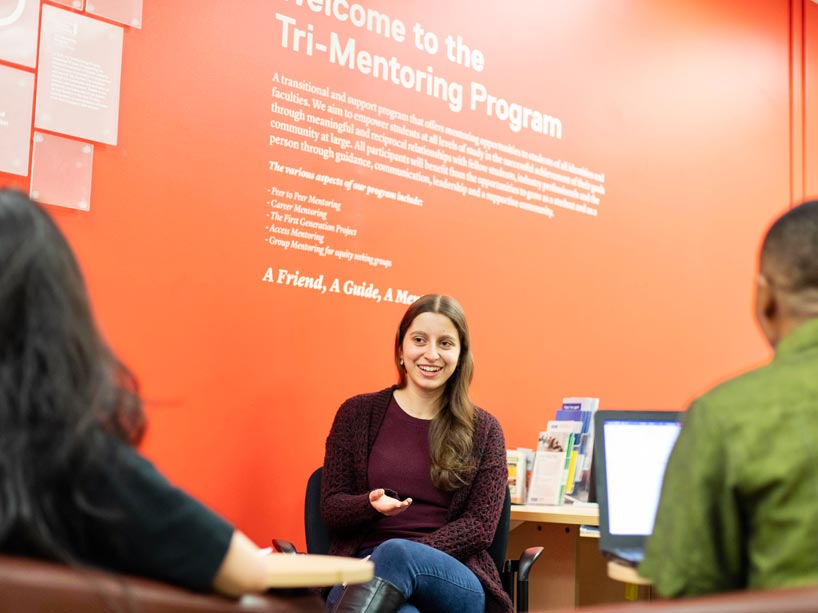
“This program was created to give students with disabilities the space to really be themselves,”says biomedical sciences student Samantha Tome, group mentoring lead at the Tri-Mentoring Program’s Group Mentoring for Students with Disabilities. Photo credit: Alia Youssef.
Student life can involve a minefield of challenges for students with disabilities, but finding a safe space to get support, connect with others and share experiences can help. The Tri-Mentoring Program’s Group Mentoring for Students with Disabilities is such a space.
Inclusive programming
“This program was created to give students with disabilities the space to really be themselves,” says biomedical sciences student Samantha Tome, group mentoring lead at the program.
“Along with bringing in speakers, and giving presentations, we also have group discussions, share our experiences and learn from one another.”
The program is open to any student identifying with a visible or invisible disability, but Tome notes that participants aren’t obliged to disclose their disability when attending events.
“A lot of students may not feel comfortable sharing the specifics of their challenges, especially if it’s an invisible disability, such as a psychological condition or a learning disability. It’s completely up to them, we want everyone to feel as safe and comfortable as possible.”
Through the program, students can be connected with, and referred to, the resources they need to deal with a range of issues – from accommodation and accessibility to applying for scholarships.
“We can help individuals apply for scholarships for that are open to students with disabilities,” said Tome. “We can provide some advice about that, and help with writing applications.”
Accessibility and inclusion
Tome is encouraged by the efforts being made across campus to make the university more accessible to all students.
“Despite the ongoing construction on campus, I am hopeful that it will make the campus a lot more accessible to students with disabilities,” she said. “Also, I’ve found that in the years I’ve been here, I’ve noticed that professors and staff seem more open to talking about accommodation and how to better assist students with disabilities.”
Tome has been gathering recommendations for the program next year, as she’ll continue her role as group mentoring lead in the fall.
“Being a student with a disability at a post-secondary institution can make you feel like you don’t belong on campus sometimes,” she said. “I think it’s important to provide a listening ear – when you let students know they're not alone and that other people are going through similar things, it makes them feel more confident and more welcome on campus.”
The Tri-Mentoring Program offers group mentoring for students who identify with seven equity-seeing groups: Students with Disabilities, Mature Students, 2SLGTBQ+, Muslim Women, Latinx/Hispanic or Spanish Speaking Students, Lusophone (Portuguese or Portuguese Speaking Students), and Women in Science, Technology, Engineering or Math (STEM). During the next academic year, group mentoring will also be available to: Black Students, Filipinx Students, and Indigenous Students.
Learn more about the Tri-Mentoring Program’s Group Mentoring.