Addressing Legacy Inequality through the Innovative Management of Contaminated Landscapes: Can redevelopment be a vehicle for Social Justice?
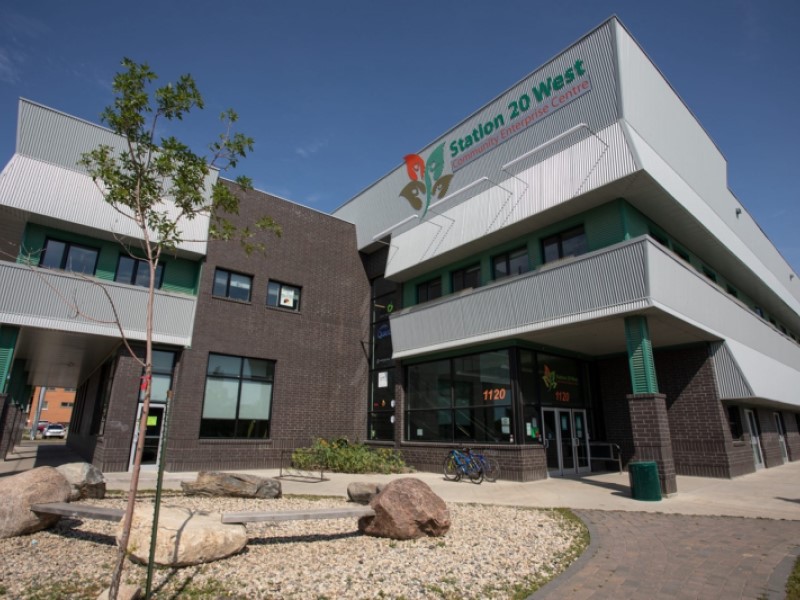
Station 20 West, a Community Enterprise Centre in Saskatoon, Saskatchewan. Built and funded by the community for the community in 2013. The guiding principals was to offer services and support towards poverty alleviation in the inner city. (Image used without permission, Station20West.org).
Our built environments reflect society: vibrant, diverse, centres of commerce, ingenuity, and arts. They are also ever increasingly inequitable spaces, divided by the haves and have-nots: post-industrial landscapes, legacy contamination, poverty, and unjust distributions of amenities scar our lands and fracture our communities. The impacts of capitalism, continued exploitation, and settler colonialism has created a perfect storm for environmental racism in Canada.
For example out of 2,300 reserves in Canada, 1,979 are affected by contamination issues. From decades-long boil water advisories to the inability to hunt and fish, sub-standard housing, poor access to food, and to living adjacent to Canada’s most toxic industrial developments like Chemical Valley, Pictou Landing First Nation, and Tar Sands, Indigenous Peoples face a disproportional number of environmental hazards. However, Indigenous environmental racism is not well explored in the literature or Canadian policy. Nor is it well understood how the process of contaminated cleanup and redevelopment occurs in Canada’s Indigenous Communities. Given that Indigenous communities lack many essential community services and infrastructure, exploring the relationship between cleanup, redevelopment, and social justice is needed to move toward a more equitable future.
There are significant proportion of contaminated sites, post-industrial, derelict or under used sites also known as brownfields that exist in poor, marginalized, and racialized communities, in both urban and rural. Indeed, early works of environmental justice and environmental racism looked at the disproportionate distribution of hazardous and polluting sites in marginalized and racialized communities. The seminal work by Dr. Bullard, Dumping in Dixie links social justice activism and the prima facie environmental racism in contaminated, toxic sites in black communities in the USA. Social justice is defined as the “equal and fair distribution of social values, freedom, income, and wealth, and the opportunity to take part in society” (McCarthy, 2010, p. 241). Considering the environmental racism impacts of contaminated land management is key to moving forward in achieving a social justice outcome.

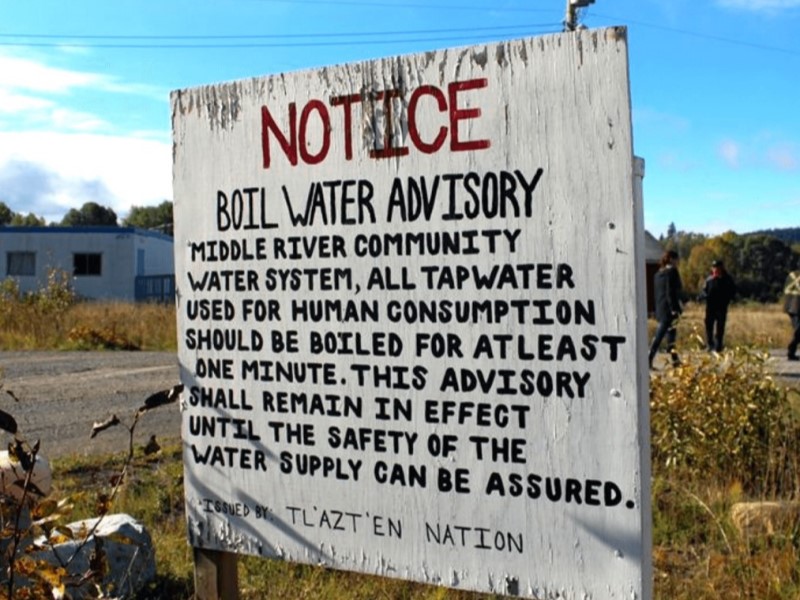
Sign indicating a 14 year long boil water advisory in the Village of Middle River in the TL’AZT’EN Nation. It was lifted in 2018, due to new technical advancement in water purification. (Image used without permission, WSP.com).
Contaminated sites (or Brownfields) in urban spaces are cleaned up via private market forces, large public works redevelop sites that renew (and can gentrify), or left idol to continue its neglected and disinvested communities. Brownfields are previously used land with real or perceived contamination and range in size to parcel size or neighbour scale. They can be cleaned up based on environmental risk, or as a community investment renewal projects. However, there are disproportional distributions of where brownfields are located. And, which sites are more likely to get cleaned up (wealthy or strategic land). The legacy of contamination and derelict sites often are concentrated in inner cities, in areas with higher poverty, and racialized groups, in a Canadian context would be Indigenous Peoples.
Brownfield literature speaks of the multi-faceted benefits that redevelopment of sites can achieve. Often researchers employ case studies to present success stories and describe various policy examples that have been implemented in communities throughout the world. However, brownfield redevelopment (BFR) can result in gentrification, which is the displacement of lower classes by higher income earners due to speculative property value and rent increases from investments in marginalized communities. There is a literature gap on BFR for development in, and the impacts to, marginalized communities, which are defined as groups that experience discrimination and exclusion based on race, gender, class, religion, political or cultural dimension. BFR literature is lacking discourses in its relationship with social justice, specifically how BF broadly impacts marginalized communities. Canadian studies link racialized environmental injustices through a general lack of investments in the most marginalized communities, such as Indigenous communities. Few articles exist on using BFR as a tool to enhance marginalized communities by tailoring development projects for those who need the most stimulus, which is the focus of this research.
This research aims to examine the benefits of brownfield redevelopment in a marginalized community, the experiences of environmental racism, and what social justice means in terms of operationalization of a future redevelopment. This research aims to fill a large literature gap that exists between contaminated sites management, Indigenous Communities, environmental and social justice, and Canadian Federal cleanup programs. This research seeks to answer how brownfield redevelopment can be a vehicle for social justice in marginalized communities, specifically Indigenous Communities in Canada?
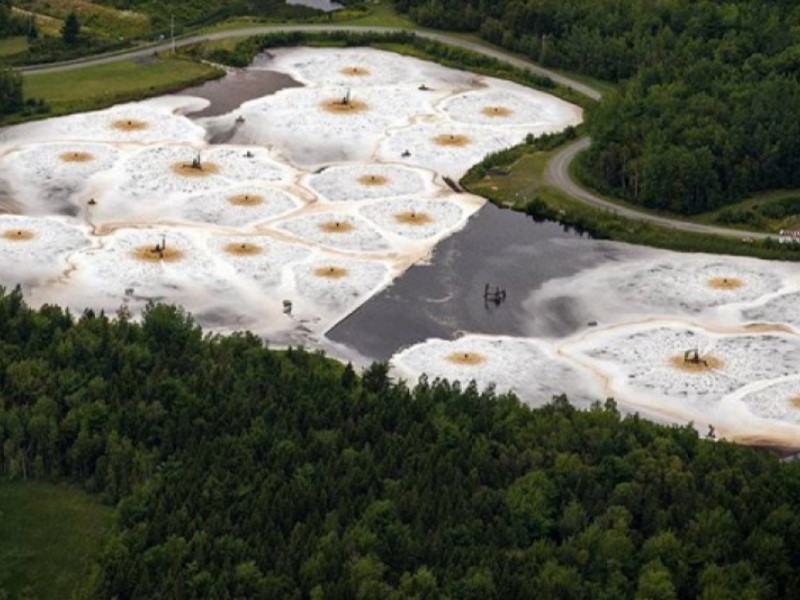
Aerators churn up mill waste in A’se’k, or “other room” in Pictou Landing First Nation’s Traditional territory. (Image used without permission).
This research is grounded in decolonization by moving beyond simply measuring a problem: this research attempts to problem solve. Additionally, the study aims to reverse the impacts of imperialism and colonial policies by addressing substandard federal policy. This research fulfils the call to action by the Truth and Reconciliation Commission to develop SJ and EJ policies, plans, and move current discourse into reconciliation.
This project has 3 major methods:
1. Semi structured, virtual, interviews with policymakers/government, NGOs, community leaders, business leaders, and industry consultants.
2. Interview users of a brownfield site that was redeveloped with a focus on social justice outcome in an inner-city, marginalized neighbourhood in Saskatoon, Saskatchewan.
3. Conduct a photovoice project with inner-city youth in Saskatoon Saskatchewan that live/attend school adjacent to a cluster of abandoned contaminated sites.
The limited research that exists within the intersection of BFR and social justice/environmental justice, rely on a mixed method approach, and several specifically include interviews as their data collection method. This research seeks to continue this analysis, but moves to examine what social justice driven brownfields can offer communities, especially within the Canadian context.

Reanne Ridsdale is a PhD Candidate at Toronto Metropolitan University and a current board member at Canadian Brownfields Network and a board member at Sustainable Remediation Forum Canada. Her research focuses on how brownfields can be strategically redeveloped as vehicle for social justice in marginalized communities, specifically Indigenous communities. She often is a sessional instructor at Brandon University, Manitoba.
Questions about the article? Contact Reanne Ridsdale directly at: dridsdale@torontomu.ca