Making the Canadian workforce more inclusive benefits the economy
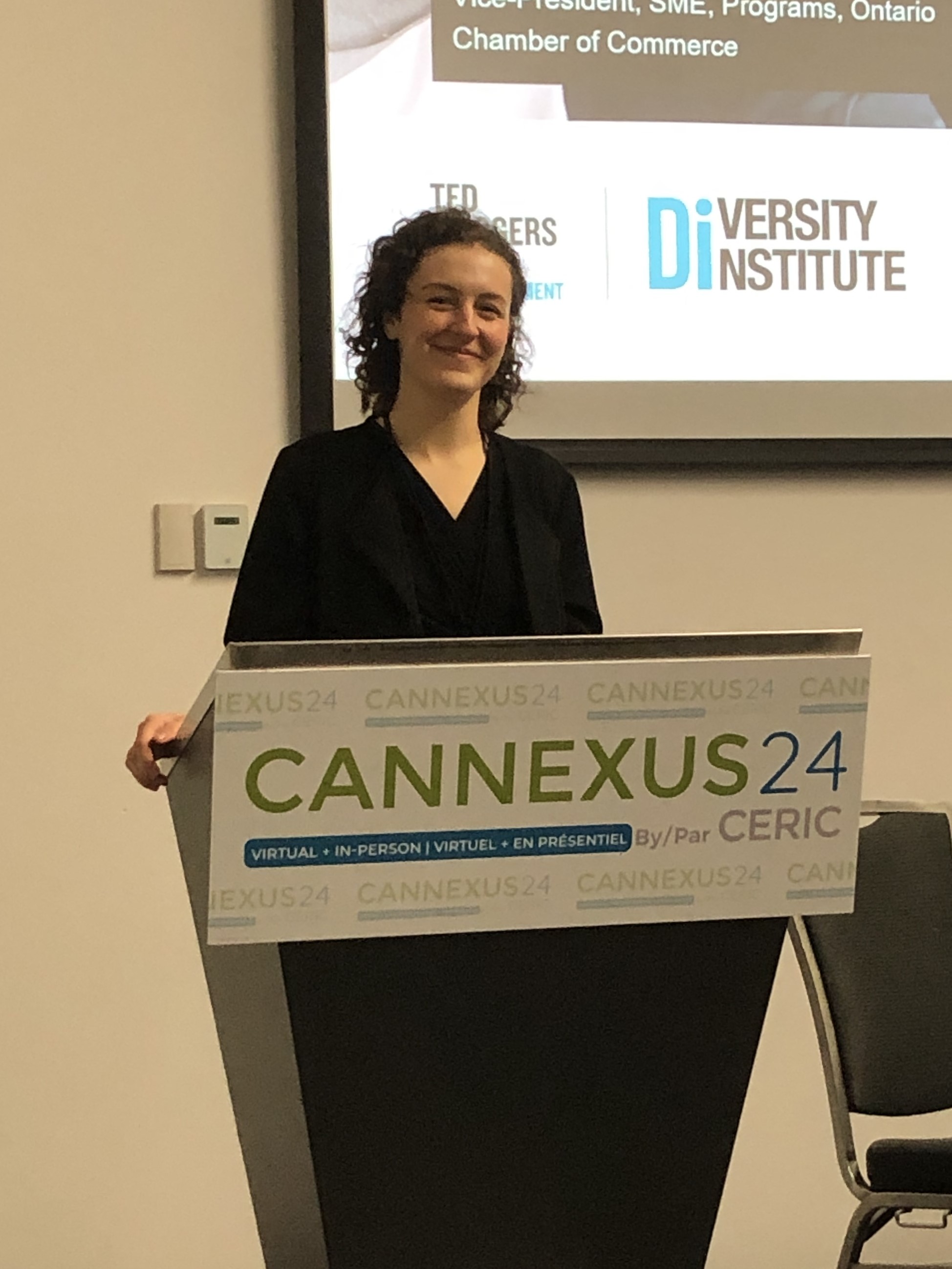
Katlynn Sverko, Director, Research - Special Projects, Diversity Institute speaks at the Cannexus24 conference in Ottawa, Ont.
This year's Cannexus, Canada’s largest conference focused on career and workforce development, was held in Ottawa and virtually from Jan. 29 to 31. The Future Skills Centre (external link) (FSC) hosted several sessions, and Wendy Cukier, founder and academic director of the Diversity Institute (DI) and research lead for FSC, presented along with other staff and partners showcasing work on trends in the future of work, innovative programs and strategies to advance inclusion.
Cukier delivered a presentation on the skills implications of Canada’s net-zero economy. She started by showing how Canada’s current emissions targets will result in increases in green jobs. As DI research has shown, this will also result in job reductions in more carbon-intensive industries, leading to up to 400,000 workers needing reskilling and upskilling for new green jobs.
Cukier said that better skills definitions will ensure that upskilling and reskilling programs for green jobs teach the right skills and help workers from equity-deserving groups overcome barriers. Previous DI research on trends in green skills has shown that while science, technology, engineering and math skills are in demand, so are critical thinking, problem solving and socio-emotional skills like teamwork and communication. Cukier noted that getting better and more accurate assessments of skills needed for jobs also helps drive inclusion, as many members of equity-deserving groups are under-employed. Soon-to-be-released research from DI and Coralus (external link) shows how innovative women greenpreneurs are playing leading roles in the green economy, highlighting the benefits of a more inclusive workforce.
Tania Saba, BMO chair in diversity and governance and professor in the School of Industrial Relations at Université de Montréal; Katlynn Sverko, director of research - special projects, DI; and Louie Di Palma, vice-president of Small and Medium-sized Enterprise (SME) programs of the Ontario Chamber of Commerce (external link) (OCC), presented on meeting the skills needs of SMEs. Small and medium-sized enterprises represent nearly 90% of private sector employment but many are reporting labour shortages or a lack of skilled workers. In her previous work, published by FSC and DI, Saba has also shown that SMEs often lack the resources and time to train new hires or upskill their staff.
With major changes in the labour market as a result of labour shortages and an increasingly diverse Canada, new approaches are needed for SMEs to attract new hires and retrain staff with the skills they need to grow, she said. Saba’s research has revealed that less than one-half of SMEs surveyed said they were very prepared for labour market challenges. She also noted that socio-emotional skills provide an excellent foundation for learning new skills. However, while 75% of firms said they want to invest in training, only 56% said they were likely to do so.
Louie Di Palma then introduced the audience to the OCC’s learning management system, co-developed with DI and Magnet (external link) , and funded by FSC. The learning management system has been successfully tested by nearly 800 SMEs across four testing phases and been released for wider beta testing. Katlynn Sverko then discussed some promising pilot programs that DI has run or evaluated recently. In particular, she discussed the ADaPT4Success program that delivers digital training and work-integrated learning for recent graduates at SMEs in need of skilled employees. Sverko also mentioned other successes, including the FSC-funded Black African and Caribbean Entrepreneurship Leadership Training Program and the Capital Skills programs.
The DI team also organized a virtual presentation led by the CEO of BrandEQ, Nadine Spencer, and DI’s executive director, Mohamed Elmi. In a presentation titled Advancing Skills Training for Black Youth, they explored the barriers that Black students face in the skills ecosystem. Elmi said, “I’m not breaking any news by saying the Black population is very diverse.” While Canada’s Black community is large and diverse, Black Canadians, especially youth, face higher unemployment and underemployment than the rest of the Canadian population. Black students also face significant challenges in education, resulting in lower report card scores, graduation rates and university attendance. “Although Black student graduation rates are improving, they are still much lower than non-racialized students,” said Elmi.
Skills and career programs can be made more inclusive for Black youth, he added. “Programs must meet people where they are to overcome the barriers they face,” he said. Tailored wraparound supports, like job placements, financial support, mentorship and counseling, are examples of the kinds of supports helping Black students. However, Elmi emphasized that more program evaluation, like that supported by FSC, is essential. He highlighted that “Only 3% of programs with wraparound supports have been evaluated,” and emphasized that To make these programs more effective, we must know the best combinations of supports that enable students from equity-deserving groups to succeed.
“The journey towards equity and opportunity for Black youth in education and employment is vital and ongoing.”
Spencer then highlighted programs that have helped Black youth and young Black entrepreneurs succeed. One is ADaPT for Black Youth (external link) , which helps participants learn the kinds of digital skills that are essential in today’s labour market. The Black African and Caribbean Entrepreneurship Leadership (external link) Training Program helps aspiring Black entrepreneurs learn valuable business skills. “The goal is to provide mentorship and guidance through the financial process,” she said. The results are encouraging, with 87% of participants saying they are satisfied with what they learned. She also pointed to the Capital Skills and BBPA’s RiseUp Pitch (external link) competitions as the kind of innovative programs that are helping Black entrepreneurs overcome the barriers they face to succeed as business owners. “The journey toward equity and opportunity for Black youth in education and employment is vital and ongoing,” she said.