Josel Angelica Gerardo on identity and civic action
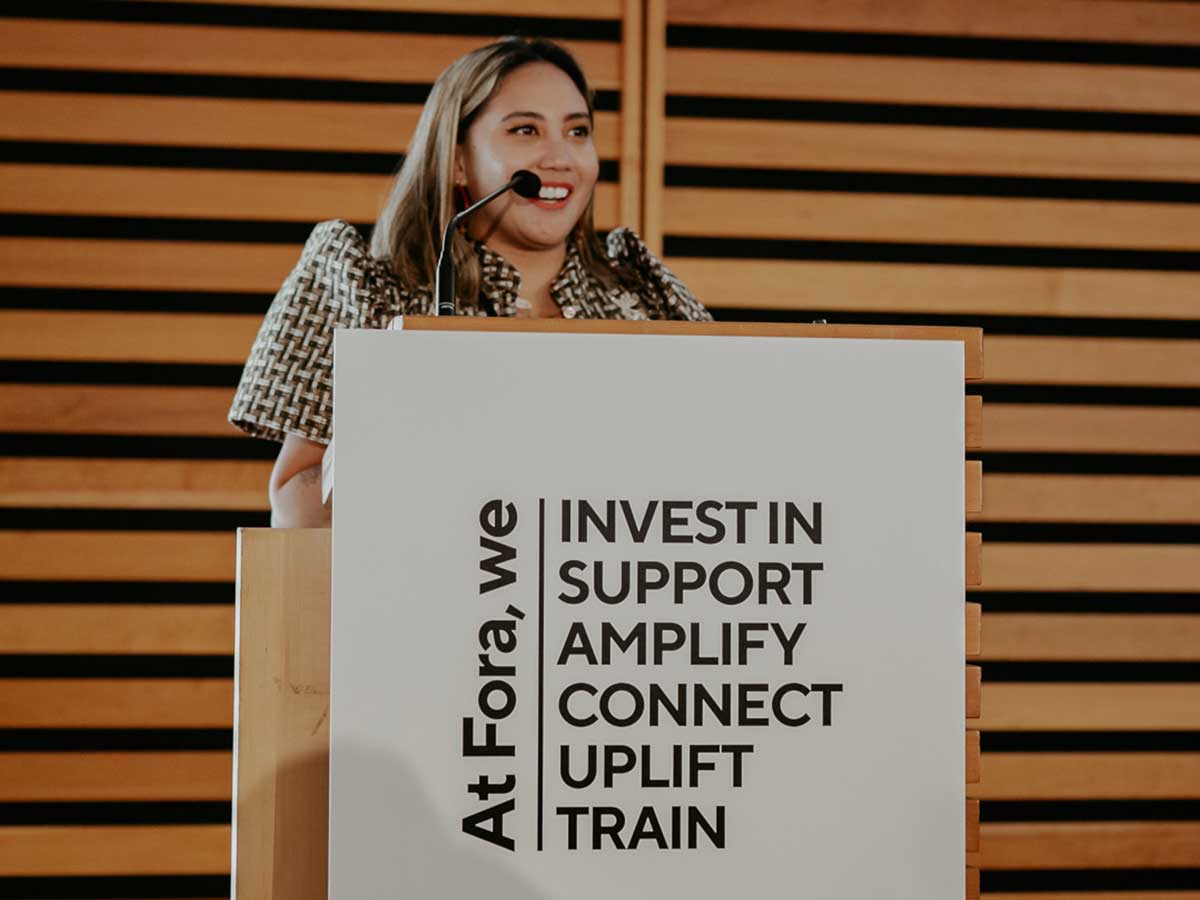
Josel Angelica Gerardo speaks at an event amplifying the conversation on feminist leadership.
For Josel Angelica Gerardo, Politics and Governance ’21, civic engagement is rooted in lived experience, shaped by her journey as a Filipina immigrant and her work in community.
A Philippine-born, Toronto-raised community organizer, Gerardo’s understanding of identity and belonging has been deeply influenced by her experience of migration. She describes immigrating to Canada as a journey that was filled with grief and which, over time, became a source of motivation.
“It was a key moment of my life,” she said. “It was difficult and challenging, but now, I’m fuelled by it because immigrating from the Philippines was political.”
Her mother’s decision to move the family in search of better social and economic opportunities shaped how Gerardo understands the relationship between personal experience and broader systems — a realization that continues to guide her approach to identity, belonging and collective action. This ultimately led her to study political science at Toronto Metropolitan University (TMU) and, more importantly, to immerse herself in community advocacy, as she began to see how lived experience and systems of power intersect in practice.
From political science to grassroots organizing
While Gerardo initially envisioned a future in law, her path shifted as she became more involved in volunteering and political engagement, where she discovered grassroots organizing as a more direct way to connect with and advocate for local communities.
“Rooted in the local community has been the core of my work in everything I do and where I know that a meaningful impact can be made,” she said.
Through her work with Filipino-Canadian and diaspora communities, she has seen how barriers to participation within the broader community can take shape in everyday interactions. She points to apathy as one of the most significant challenges, noting that many people feel disconnected from systems they no longer believe will improve their lives.
“Seeing civic engagement and ‘democracy in action’ means being physically present in the community and being boots on the ground,” she said. “It’s more than a social media post.”
That approach was shaped in part by her time at TMU, where she built a foundation in political theory and applied it through student leadership, on-campus work and research opportunities. These experiences helped her develop the skills to translate ideas into action — something she continues to carry into her work today.
Now, as an alumna, she remains connected to the TMU community, engaging both students and fellow alumni in civic spaces and conversations.
Community care, representation and collective responsibility
Moments of collective reflection have also influenced her advocacy. Following the anniversary of the Vancouver Lapu-Lapu Day festival tragedy in April 2025, Gerardo emphasizes the importance of moving beyond narratives of resilience alone. In her work with the Filipino-Canadian Civic Action Network, she has focused on engaging community members directly, asking what they want to see from governments and decision-makers moving forward.
“This is how we care for each other, by being in community, by advocating and by being on the ground listening and sharing stories with each other,” she said.
As she reflects on Asian Heritage Month this May, representation remains central to her perspective. Seeing people who share her identities in civic and political spaces, she says, is both affirming and motivating — a reminder that those barriers can be overcome.
“It means that someone was able to pass through all the barriers and thrive … This gives me and the communities I’m a part of hope.”
That sense of possibility is something Gerardo hopes continues to grow. Looking ahead, she emphasizes the importance of creating pathways for others, ensuring that future generations not only see themselves represented, but also have the opportunity to take up space and contribute to change.
Do you want to be featured in an upcoming issue of Toronto Met Connect?
Share your journey — email us!